

In this report
Americans really do appear to be getting more active.
For the 12 months ending in June 2026, 81.3% of Americans age six and older participated in at least one of 126 sports and fitness activities tracked by the Sports & Fitness Industry Association (SFIA).
According to SFIA’s latest participation data, this pushed the inactivity rate down to 18.7%, the lowest level SFIA has recorded.
I like this statistic. More than most fitness numbers, actually.
There is one fairly large catch, though. An 18.7% inactivity rate does not mean 81.3% of Americans exercise regularly, and it definitely does not mean four out of five Americans meet physical activity guidelines.
What it tells us is that fewer Americans are doing absolutely nothing. Still, I think that is a genuinely encouraging development.
Inactivity Has Been Falling for Years
The 18.7% figure looks more meaningful when you stop treating it as an isolated 2026 statistic.
Physical Activity Council data show a remarkably consistent decline in inactivity among Americans age six and older:
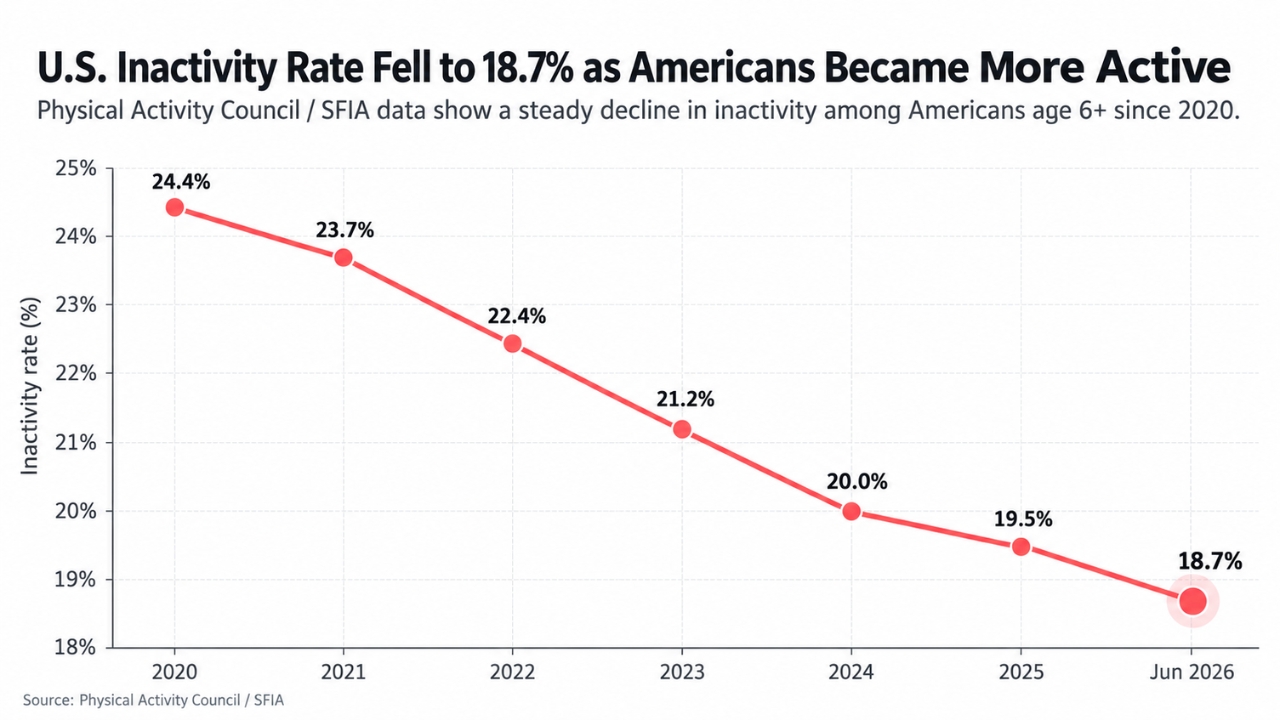
Between 2020 and 2025 alone, the estimated number of inactive Americans fell from 74.3 million to 60.7 million, even as the population represented in the survey grew.
The 2026 mid-year figure then pushed the rate lower again.
The national trend also hides weaker results among younger Americans, including a recent decline in U.S. teen physical activity.
That sustained direction is what gets my attention.
I’ve spent enough time looking at participation surveys to be skeptical of a dramatic one-year movement. Surveys bounce around. Definitions matter. Samples change slightly. People’s memories of how much exercise they did are not exactly laboratory instruments.
Six years moving mostly in one direction is harder to dismiss.
From 24.4% in 2020 to 18.7% in 2026 is a 5.7 percentage-point decline, or roughly a 23% reduction in the inactivity rate. That’s substantial.
“Active” Is Doing a Lot of Work Here

Here is where I want to put a large asterisk next to all the celebrating.
SFIA’s measure asks whether people participated in at least one of the activities it tracks over the preceding 12 months. The organization currently tracks 126 sports and fitness activities.
Someone does not have to be jogging four mornings a week, lifting weights three times a week, or hitting 10,000 steps every day to escape the inactive category.
And frankly, that’s fine. It just means we need to call the statistic what it is.
This is a participation measure, not a measure of whether Americans exercise enough for optimal health.
I find that distinction more interesting than disappointing. Fitness culture has a strange habit of treating people as either dedicated exercisers or sedentary failures. Population data are messier.
A person who starts walking occasionally, joins a recreational basketball game, hikes a few weekends, or begins swimming has moved from nothing to something. From a public-health perspective, that transition matters.
You don’t need to become the person posting a 5:12 a.m. treadmill selfie for physical activity to count.
Most Americans Still Aren’t Meeting the Full Guidelines
Here is the other side of the story.
The current federal activity guideline for adults calls for at least 150 minutes of moderate-intensity aerobic activity per week, or 75 minutes of vigorous activity, plus muscle-strengthening activity on at least two days.
Similar exercise guidelines for heart health also emphasize regular aerobic activity alongside strength work.
View this post on Instagram
The numbers look much less impressive when we use that standard.
National Center for Health Statistics data for 2024 found that 47.2% of U.S. adults met the aerobic activity recommendation. Interestingly, that figure sits very close to the 46% wearable ownership rate among U.S. adults, although the two statistics measure very different things.
Men were more likely to meet it than women, at 52.3% compared with 42.4%, according to the NCHS analysis of adult activity.
Add the muscle-strengthening requirement and the percentage falls further. Healthy People 2030 reports that 26.4% of adults met both the aerobic and muscle-strengthening guidelines in 2024.
So we can have all of these statistics at the same time:
- 81.3% participate in at least one tracked activity.
- Fewer than half of adults meet the aerobic recommendation.
- Roughly one in four adults meet both aerobic and strength recommendations.
For adults who struggle to fit strength exercise into their schedules, supersets offer a faster workout option without necessarily compromising results.
None of them contradict the others.
They are answering different questions.
This is exactly why I get nervous when one exercise statistic is used to describe how “active America” is. You have to ask what active meant in the survey before the percentage tells you very much.
Still, Moving People Out of the Zero Category Matters
I don’t think we should respond to the 18.7% number by saying, “Well, most people still don’t meet the guidelines, so who cares?”
I care.
For people who are largely inactive, health benefits begin before they reach 150 minutes per week. Federal guidance explicitly emphasizes that some activity is better than none and recommends that inactive people start with small amounts and build upward.
That makes the bottom end of the activity distribution especially important.
Getting somebody from zero activity to a little activity is not a meaningless first step on the way to becoming “properly fit.” It has value by itself.
I actually think fitness culture gets this backwards surprisingly often. We obsess over whether somebody should train four days or five, whether Zone 2 should last 45 minutes, and whether 8,000 steps are secretly inferior to 10,000.
At the population level, getting millions of people from nothing to something is a much bigger deal.
Team Sports Are Helping Push Participation Higher
The latest increase isn’t coming from one activity.
SFIA reported that team sports were the fastest-growing major category in its mid-year data, rising 3.8%. Basketball, flag football, and baseball were among the activities showing notable gains, and team-sport participation has now increased for three consecutive years.
Soccer also got a noticeable 2026 bump. Outdoor soccer participation increased 6.2%, and indoor soccer rose 5.3% in data that covered the opening period of the 2026 World Cup. Padel increased 14.5%, although it is starting from a much smaller participation base.
Pickleball provides another example of the rapid expansion of recreational sports. An estimated 24.3 million Americans played pickleball in 2025. The highest participation rate now belongs to people ages 13–24, a notable shift for a sport once associated primarily with retirees.
Research from the Sports & Fitness Industry Association shows that soccer participation in the U.S. has never been higher going into the FIFA World Cup.
– Outdoor soccer reached 16.8M Americans (+15.8%)
– Indoor soccer grew to 6.6M (+10.5%) https://t.co/Otd2oXuzg2— Sportico (@Sportico) May 12, 2026
I find the team-sport growth particularly interesting because physical activity becomes easier to maintain when it has another purpose attached to it.
You aren’t necessarily “doing cardio.” You’re playing basketball with friends.
That distinction sounds trivial until you’ve spent years looking at why people start exercising and why they stop. Enjoyment, convenience, and social connection can matter a lot more for adherence than knowing the recommended number of weekly minutes.
Cost Could Put the Progress at Risk
There is one number in SFIA’s report that I wouldn’t ignore.
26.9% of participants said out-of-pocket costs had affected how they participate, and 30.2% said their participation costs had increased from the previous year.
Among people already affected by costs, 24.9% said they were very unlikely to continue their current activities if costs kept rising.
This matters because activity is not simply a motivation problem.
Gym fees cost money. Youth sports cost money. Equipment costs money. Premium home fitness equipment can raise that barrier further, as prices for Peloton’s new treadmills show.
Free gym access can remove part of that financial barrier. Planet Fitness provided free workouts for teenagers through its summer program in 2026, with approximately 3.7 million teens participating.
Transportation costs money. Even finding enough free time to exercise becomes easier or harder depending on someone’s job, childcare responsibilities and neighborhood.
I dislike explanations of inactivity that reduce the entire issue to personal discipline. They’re neat, easy to repeat and not particularly good descriptions of real life.
If participation has genuinely improved across the country, keeping activities accessible is part of maintaining that progress.
The Bigger Story Is the Direction of Travel
I wouldn’t read the 18.7% inactivity rate as proof that America has suddenly become a nation of devoted exercisers.
It hasn’t.
Millions of people remain inactive, and a much larger group participates in some physical activity without accumulating enough to meet the full recommendations. There are also important differences by age, sex, income and other demographic factors that disappear when everything gets compressed into one national percentage.
Still, the trend deserves some optimism.
Inactivity fell from 24.4% in 2020 to 19.5% in 2025 and has now reached 18.7% in the latest 12-month data. Participation has moved in the opposite direction and reached a record high.
That broader shift also shows up in record U.S. gym membership, which reached 81 million members in 2025.
Personally, I think the most encouraging part is that the improvement doesn’t require us to believe everybody has suddenly fallen in love with structured exercise.
People are walking, lifting, hiking, playing sports, swimming, cycling and finding other ways to move.
Some are doing a lot. Some aren’t doing enough yet. And increasingly, fewer are doing nothing.
From where I sit, that is the statistic worth celebrating.