
In this report
Pickleball has apparently outgrown its reputation as a retirement-community pastime. According to the Sports & Fitness Industry Association’s 2026 report, Americans ages 13 to 24 now have the highest pickleball participation rate of any age group.
The findings cover participation in 2025, when an estimated 24.3 million Americans played the sport. I find the age breakdown more interesting than the enormous growth figure we’ve become accustomed to seeing.
Pickleball has been expanding for years. What we’re seeing now is evidence that younger Americans have embraced a sport once associated primarily with older adults.
And that could be considerably more important for its future than another year of double-digit growth.
Young Americans Are Leading Pickleball Participation
The first distinction worth making is between participation rates and the total number of participants.
A participation rate measures the share of people within a particular population who take part in an activity. A participation count measures how many people participate. Those are different statistics.
For example, an age group with fewer people overall can have a higher participation rate without having the largest number of players.
SFIA’s latest announcement identifies the 13–24 age group as having the highest rate, although its publicly released summary doesn’t provide the exact percentage for each age category.
That’s an important limitation. We know which age segment leads, but the public figures don’t tell us how far ahead it is.
For comparison, an earlier SFIA participation report found that Americans ages 25–34 represented the largest number of pickleball participants in 2023, with approximately 2.3 million players.
The two findings aren’t contradictory. They describe different years and measure different things.
Another notable trend appeared in the fitness industry: 35.5% of Americans ages 18–24 held a fitness facility membership in 2025, the highest rate of any age group.
My takeaway is that pickleball’s popularity among younger Americans deserves to be treated as a genuine participation trend, rather than an amusing exception to its older-player reputation.
Pickleball’s Growth Since 2020 Has Been Remarkable
The broader numbers help explain why this demographic shift matters.
Pickleball grew from approximately 4.2 million American participants in 2020 to 24.3 million in 2025, according to SFIA’s participation statistics.
That’s an increase of roughly 479% in five years.
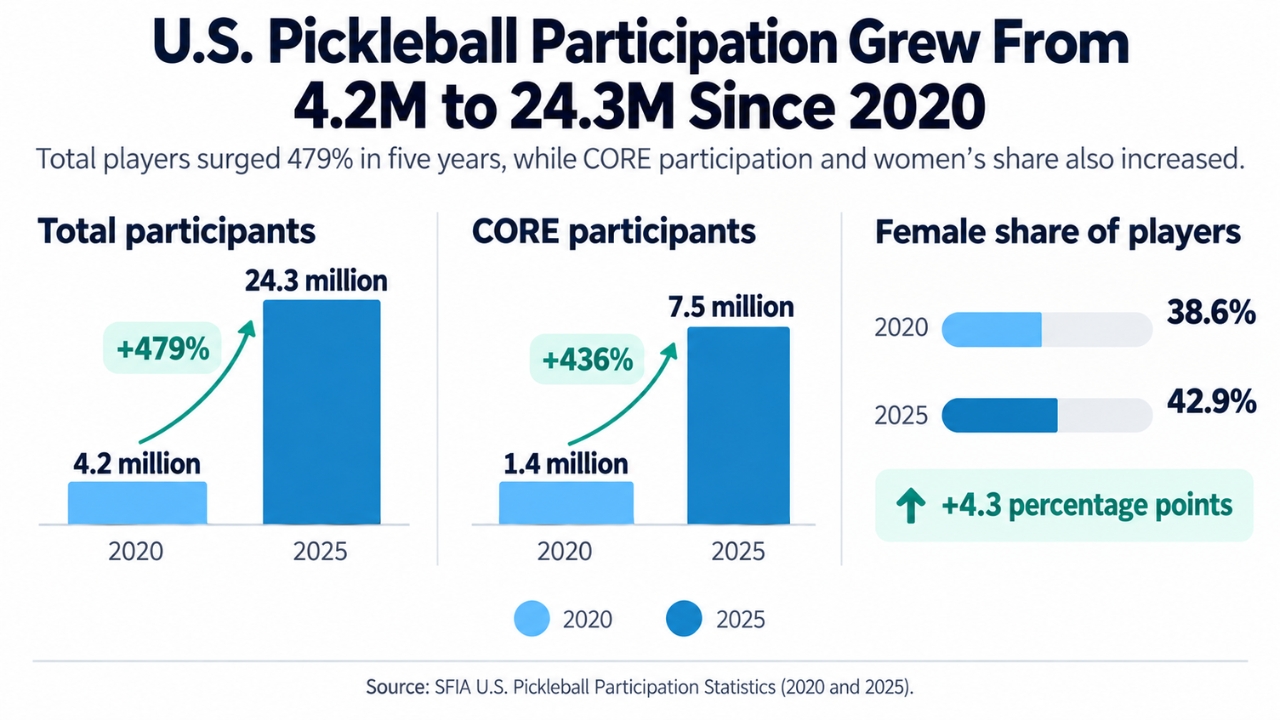
CORE participants are people who play at least eight times annually.
What catches my attention is that growth isn’t confined to a single measure. Total participation has expanded, more people are playing repeatedly, and the gender distribution has become somewhat more balanced.
Women’s share increased by 4.3 percentage points over five years. I wouldn’t interpret that as evidence that pickleball has achieved equal participation across demographics. It hasn’t.
Still, when a sport expands this quickly and attracts a broader population, it becomes harder to dismiss its popularity as temporary enthusiasm.
Why Pickleball Appeals to Younger Players
The SFIA figures establish that younger Americans are participating at high rates. They don’t establish precisely why. I think several characteristics of the sport offer plausible explanations.
Getting Started Doesn’t Require Years of Practice
Pickleball has a relatively approachable learning curve.
The smaller court, straightforward basic rules, and slower-moving ball compared with many tennis rallies allow beginners to start playing recreational games without extensive technical preparation.
That doesn’t make competitive pickleball easy. Experienced players develop sophisticated positioning, control, and strategy.
It simply means beginners can enjoy meaningful participation before becoming particularly skilled. I think fitness discussions underestimate how important that immediate enjoyment can be.
People are more likely to return to an activity when their first few experiences are enjoyable rather than frustrating.
The Social Side Is a Major Advantage
Pickleball also fits naturally into group recreation. Doubles matches involve four players, games can be relatively short, and participants can rotate partners during casual sessions.
For teenagers, college students, and young adults, the sport provides an opportunity to socialize while being physically active. That’s appealing from a participation perspective.
A similar social pattern appeared in Planet Fitness’s free teen workout program, where 53% of surveyed participants said they regularly exercised with a friend.
I’ve never been particularly convinced that people need to approach every recreational activity primarily as exercise. Sometimes the motivation is simply having fun with friends.
The physical activity is still real even without a wearable fitness device, a product category now owned by 46% of U.S. adults.
Popularity Among Young Players Doesn’t Mean Teen Inactivity Is Solved
Here’s where I think the pickleball story needs some perspective.
The same organization reporting extraordinary growth in pickleball also found that inactivity among teenagers ages 13–17 increased by 4.4% year over year in 2025, despite declining across the other age groups it examined.
According to SFIA’s broader 2026 participation findings, overall American sports and fitness participation reached a record high. Yet teenage inactivity moved in the opposite direction.
The contrast is even clearer at the national level, where the U.S. inactivity rate fell to 18.7% in the 12 months through June 2026.
We also recently examined how teen physical activity has declined across several measures in the CDC’s latest national research.
Only 25% of U.S. high school students reported getting at least 60 minutes of physical activity every day in 2025. I don’t see these findings as contradictory.
Pickleball can become increasingly popular among young people who already enjoy recreational sports without substantially changing the activity habits of teenagers who rarely participate.
There’s another distinction: the leading pickleball category combines ages 13–24, whereas the teenage inactivity figure concerns ages 13–17. We shouldn’t assume both subsets have identical participation patterns.
A sport can be thriving among younger Americans without solving the broader problem of insufficient youth physical activity.
The return of the Presidential Fitness Test brings that concern into schools, where fitness assessments must serve students with very different levels of physical activity.
That’s the distinction I would keep in mind before declaring pickleball a public-health success story.
Playing Pickleball Once Isn’t the Same as Playing Regularly
Another statistic deserves more attention. Of the 24.3 million Americans who participated in pickleball during 2025, approximately 7.5 million qualified as CORE players.
Fun fact: 24.3 million Americans played pickleball in 2025. It was the country’s fastest-growing sport for the fifth straight year.
Getting into a home is step one. The neighborhood is what comes next.
Proud to be the title sponsor of the 2026 Pickleball World Championships in Dallas, Oct. 30 to Nov. 8.
Homeowners make communities better.
https://t.co/7BxhMDHygQ
— Morgan Brown (@morganb) September 1, 2026
That works out to roughly 31% of all participants. In other words, about seven in ten participants did not reach the threshold of eight sessions during the year.
I find that percentage useful because it separates widespread experimentation from more established participation.
Someone who played pickleball twice during summer vacation counts toward the broader participation figure. So does someone who plays several times every week.
Those are very different activity patterns. Even the CORE threshold of eight annual sessions isn’t especially demanding.
Adult weekly exercise guidelines focus on activity minutes rather than the number of times someone participates in a particular sport each year.
And neither figure tells us how many young people are playing consistently enough to contribute substantially to their weekly physical activity. That doesn’t diminish the sport’s popularity. It tells us what the statistics can actually establish.
For a sport growing this quickly, I would pay at least as much attention to repeat participation as to the number of first-time players.
Access Could Determine Whether the Youth Boom Lasts
There’s another question I think deserves more attention: who actually gets the opportunity to play?
Pickleball equipment can be relatively inexpensive, particularly compared with sports requiring extensive protective gear or specialized facilities. Court availability is another matter.
Access depends on where someone lives, whether public facilities exist, transportation, court scheduling, and the cost of organized programs or private clubs.
Those barriers are particularly relevant for younger participants who don’t control their household budgets or transportation.
One encouraging development came in April 2026, when USA Pickleball announced a partnership with Boys & Girls Clubs of America.
View this post on Instagram
The partnership aims to expand youth access through equipment, programming, and community organizations. I like initiatives built around existing youth facilities.
They’re more likely to reach children who aren’t already connected to organized recreational sports.
Of course, announcing a program and demonstrating sustained increases in activity are different accomplishments. Its long-term results will matter more than the initial ambition.
What the Changing Age Profile Means for Pickleball
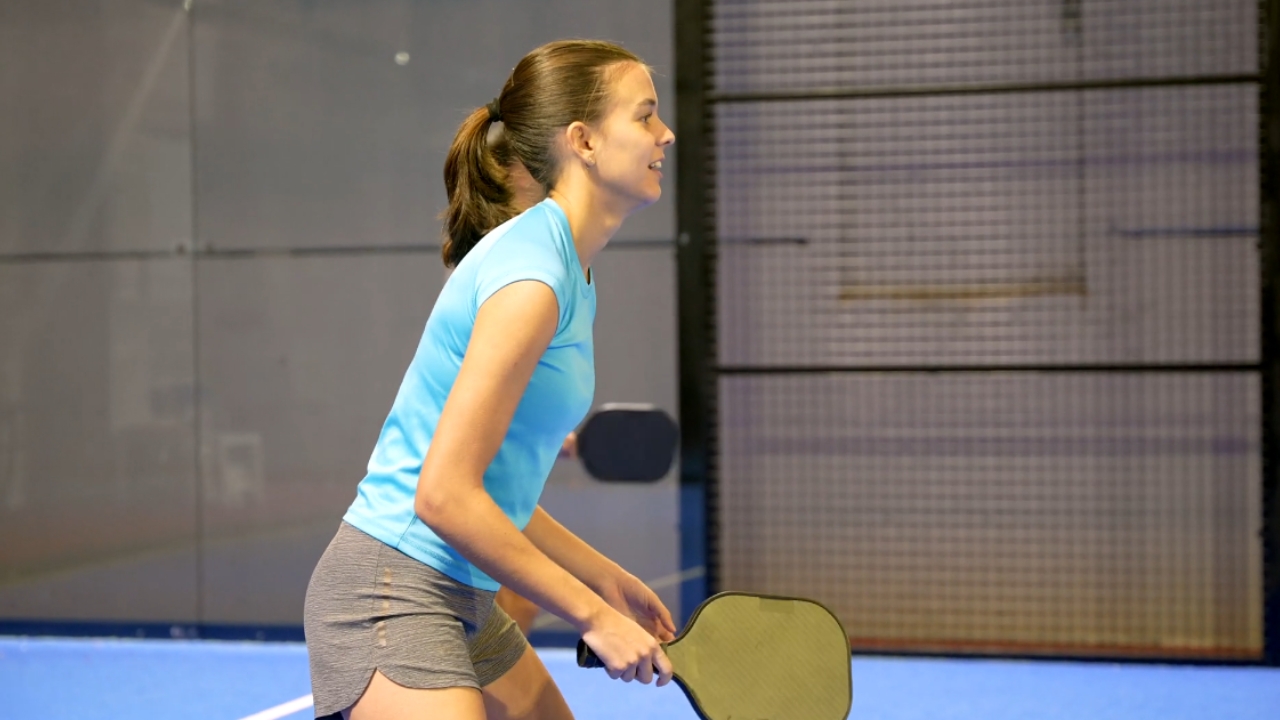
I think pickleball has reached an interesting point in its development.
The debate used to center on whether its explosive growth would last. Now we’re seeing a broader participation base, considerable repeat engagement, and an age profile that challenges the sport’s original public image.
The 13–24 finding is particularly meaningful because younger players potentially have decades of recreational participation ahead of them.
That doesn’t guarantee they’ll continue playing. Interests change, schedules become busier, and recreational trends lose momentum.
What I’d like to see next is more detailed evidence showing whether younger participants continue playing regularly, how their habits change over time, and whether access improves for groups currently underserved by recreational facilities.
For now, the numbers justify a clear conclusion.
Pickleball is no longer primarily a sport we should associate with older Americans. Younger people are participating at the highest rate, and the sport’s future increasingly depends on whether that enthusiasm becomes a lasting habit.
Personally, I find that more interesting than another record-breaking participation headline.