
In this report
Nearly 40 million American adults cannot swim. In one of the wealthiest countries on Earth, we’ve somehow accepted that as normal.
Americans spend billions on gym memberships, fitness trackers, and exercise equipment. Yet a basic survival skill remains out of reach for millions. I find that indefensible.
According to the CDC, 39.5 million adults say they cannot swim, and more than half have never taken a swimming lesson.
Before blaming individual choices, consider who can actually afford lessons, access a public pool, or grow up in a community where learning to swim is even an option.
America doesn’t have a swimming motivation problem. It has an access problem. And we’ve spent decades pretending otherwise.
Nearly 40 Million Adults Cannot Swim, According to the CDC
More than 40 million U.S. adults don’t know how to swim. This summer, be sure you and your family have basic swimming and water safety skills, so everyone can enjoy the water! https://t.co/lqjDjxYy6f #CDCSummerSafety https://t.co/sf2cwwDPXc
— CDC (@CDCgov) July 23, 2024
The figures come from nationally representative survey data collected in October and November 2023. Researchers found that 15.4% of U.S. adults reported not knowing how to swim.
Another finding deserves just as much attention: 54.7% of adults reported never taking a swimming lesson. That’s more than half the adult population.
Of course, someone can learn to swim without formal instruction. Plenty of people do. But these numbers expose how casually we’ve treated the responsibility of teaching water safety.
Children generally aren’t expected to teach themselves to read, understand traffic signals, or learn basic mathematics.
Swimming, meanwhile, is often left to whether their parents can afford lessons, have transportation, or live near a suitable pool.
And if those opportunities never appear during childhood, the assumption seems to be that adults will somehow figure it out themselves.
That’s an astonishingly poor approach to teaching a potentially lifesaving skill.
The Real Swimming Problem Is Bigger Than 40 Million
The headline figure doesn’t tell the entire story. The same CDC survey found that another 17% of adults described themselves as comfortable only in water where they could stand.
Combine that group with adults who cannot swim at all, and 32.4% of respondents fell into one of those two categories.
That doesn’t mean everyone in that combined group is incapable of moving through deep water. The survey measured self-reported swimming skills, not performance in a pool.
Still, it raises questions about how we define swimming ability. Being able to splash across the shallow end is different from remaining calm when your feet cannot touch the bottom.
I’ve always found fitness measurements most useful when they tell us something practical. Swimming competence should be no different.
Can someone float, control their breathing, turn around, and reach safety?
Those abilities matter considerably more than whether they can perform an impressive butterfly stroke.
The distinction becomes especially important in open water, where currents, temperature, visibility, and fatigue can create dangers that don’t exist in a controlled pool.
Swimming Inequality Is Not an Accident
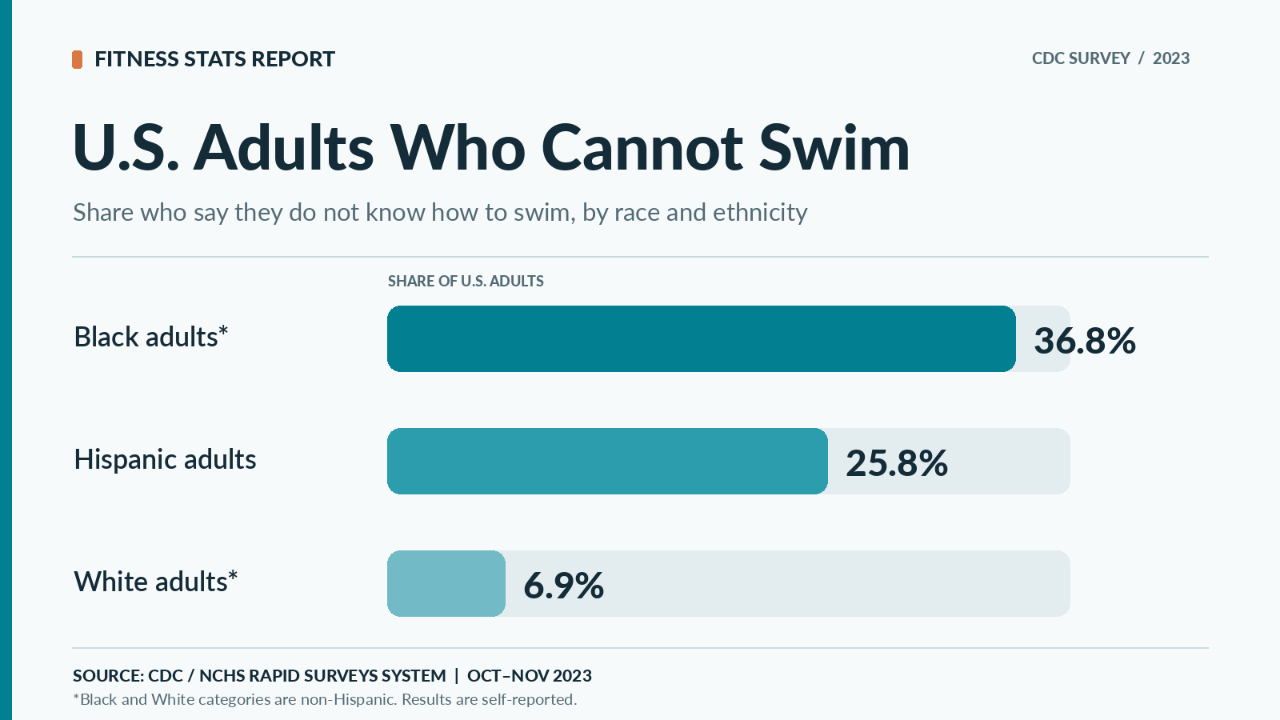
The demographic differences in the CDC survey are enormous. Among Black adults, 36.8% reported not knowing how to swim. The figure was 25.8% among Hispanic adults and just 6.9% among White adults.
That is not a minor difference requiring another decimal place to appreciate.
And I have little patience for explanations that reduce these disparities to individual confidence or personal preferences.
The CDC’s analysis of swimming disparities identifies historical discrimination, unequal access to swimming facilities, lesson costs, and cultural barriers as relevant factors.
For decades, racial segregation restricted access to public swimming pools. Some pools closed rather than integrate, while private swimming facilities created additional barriers.
The consequences didn’t simply disappear when discriminatory laws changed.
Families that lacked access to swimming facilities had fewer opportunities to develop swimming skills and pass them to their children.
The data cannot tell us exactly how much each historical or economic factor contributes to today’s disparities. But pretending that everyone starts with the same opportunity to learn is indefensible.
You cannot tell communities to take personal responsibility for swimming while ignoring whether they have somewhere affordable and welcoming to learn.
America Has a Fitness Industry, Not a Water-Safety Strategy
Consider another number. As I recently covered, U.S. gym membership reached 81 million in 2025. That’s a record.
Now place that beside the CDC’s estimate of nearly 40 million adults unable to swim.
These figures come from different years and measure different things. They aren’t evidence that gym members cannot swim, or that gym spending causes a shortage of swimming skills.
But the contrast is very much revealing.
We’re exceptionally good at turning exercise into a commercial product. We have entire industries devoted to helping people become stronger, leaner, faster, and more physically capable.
Learning a foundational survival skill, however, still depends heavily on local access and personal circumstances.
I’m not arguing that gyms should become swimming schools. I’m arguing that we have normalized an enormous gap in physical education while celebrating increasingly sophisticated ways to measure fitness.
A public swimming pool is not merely a recreational amenity. It is public health infrastructure. Communities should budget for swimming instruction accordingly.
Drowning Deaths Make the Stakes Clear
This isn’t simply about whether adults can enjoy a beach vacation. The CDC reported more than 4,500 drowning deaths annually in the United States during 2020–2022, approximately 500 more per year than in 2019.
Its January 2026 drowning data update continues to identify more than 4,000 unintentional drowning deaths annually.
Young children face particularly serious risks, while adults aged 65 and older have also experienced elevated drowning rates.
There is another detail worth examining. Women were more likely than men to report being unable to swim: 19.4% versus 11.2%.
Yet the CDC reports that nearly 80% of people who die from drowning are male. That apparent contradiction tells us something important.
View this post on Instagram
Swimming ability is only one part of water safety. Exposure to hazardous conditions, alcohol consumption, risky behavior, and failure to wear life jackets also matter.
Being a competent swimmer does not make someone immune to drowning.
The lesson should be obvious: teach swimming skills, but never confuse confidence with invulnerability.
Schools Cannot Keep Ignoring Fundamental Skills
We’ve already seen evidence that American schools are struggling to maintain regular opportunities for physical activity.
As I discussed in our coverage of declining teen physical activity, daily physical education attendance fell substantially between 2015 and 2025.
And the return of the Presidential Fitness Test raises a related question: what should physical education actually accomplish?
Measuring how fast a child runs has value. Teaching children skills that allow them to participate safely in physical activities throughout life has value, too. Swimming deserves a place in that conversation.
Not every school has access to a pool, and pretending otherwise would be absurd. But school districts can work with community facilities, swimming organizations, and local governments to expand opportunities.
A child shouldn’t reach adulthood without learning to swim simply because nobody made instruction available.
Teaching Adults Matters Just as Much
We cannot solve a problem affecting nearly 40 million adults exclusively through children’s programs. Adult swimming lessons need to become more accessible, too.
That means affordable beginner classes, evening schedules for working people, instructors experienced with fearful adults, and facilities that welcome people who have never entered a pool.
The CDC’s drowning prevention recommendations already emphasize swimming instruction alongside life jackets, supervision, and barriers around pools.
None of this requires inventing a revolutionary new fitness program.
It requires treating ordinary swimming lessons as something worth funding and making accessible.
And I would argue that an adult learning to float safely at 50 is accomplishing something more immediately valuable than shaving another few seconds off a treadmill interval.
The Fitness Skill We Have Undervalued for Too Long
The nearly 40 million figure should embarrass us collectively, not embarrass the adults who cannot swim.
Many of those adults never had a realistic opportunity to learn. Others may be dealing with fear, previous negative experiences, physical limitations, or years of avoiding situations where swimming is required.
There’s nothing productive about making them feel foolish.
But there is something deeply wrong with accepting this number as normal.
We have enough evidence to know that swimming instruction matters, enough experience to design effective programs, and enough resources as a country to make substantially better progress.
What we’re missing is the willingness to treat swimming as a public health priority rather than an optional pastime.
Nearly 40 million adults unable to swim isn’t a failure of individual fitness. It’s a failure of access, education, and priorities.
And until we address those failures, another fitness membership record won’t be much consolation.