

In this report
A strength workout lasting 75 minutes could potentially be finished in under 50. Research on supersets shows that reorganizing exercises can dramatically reduce training time while preserving muscle and strength gains.
The evidence is convincing enough that I think conventional workout programming deserves a serious rethink.
A 36% Shorter Workout Delivered Similar Gains
A 2026 study published in Science & Sports followed 43 resistance-trained adults over eight weeks.
Participants trained twice weekly using either traditional sets or supersets. Both groups performed six exercises targeting upper- and lower-body muscles.
The results were striking.
Outcome
Finding
Workout duration
36% shorter with supersets
Muscle thickness
Generally similar improvements
Strength and power
Generally similar improvements
Muscular endurance
Generally similar improvements
The 2026 superset training study provides direct evidence that substantial time savings are possible without meaningfully compromising the measured adaptations. A 75-minute session shortened by 36% would take approximately 48 minutes.
The study involved young, experienced lifters and lasted only eight weeks. Those limitations matter, particularly when considering beginners or long-term results.
Still, cutting more than a third from workout duration deserves attention.
Nineteen Studies Strengthen the Argument
A 2025 systematic review and meta-analysis published in Sports Medicine examined 19 studies involving 313 participants.
Its findings were encouraging:
- Supersets generally preserved total repetitions and training volume.
- Available longer-term studies found similar muscle growth and strength improvements.
- Supersets increased training density and perceived exertion.
Only three studies examined longer-term adaptations, so researchers still need larger, longer trials.
I think this is where fitness advice often becomes careless. Comparable outcomes in small studies get exaggerated into promises that every training arrangement will work equally well.
The evidence supports carefully programmed supersets. Their effectiveness depends on the exercises selected and the recovery provided.
Exercise Pairing Determines the Results
The simplest way to perform a superset is to complete two exercises consecutively and then rest. Pairing opposing muscle groups is particularly promising.
A 2010 study involving 16 trained men found that alternating bench pulls and bench presses maintained a greater total volume load than performing traditional sets within the same approximate workout duration.
View this post on Instagram
That gives us a practical principle: pair exercises that allow the relevant muscles to recover.
Pairings I’d Recommend
| Exercise A | Exercise B |
| Bench press | Seated row |
| Biceps curl | Triceps extension |
| Leg extension | Leg curl |
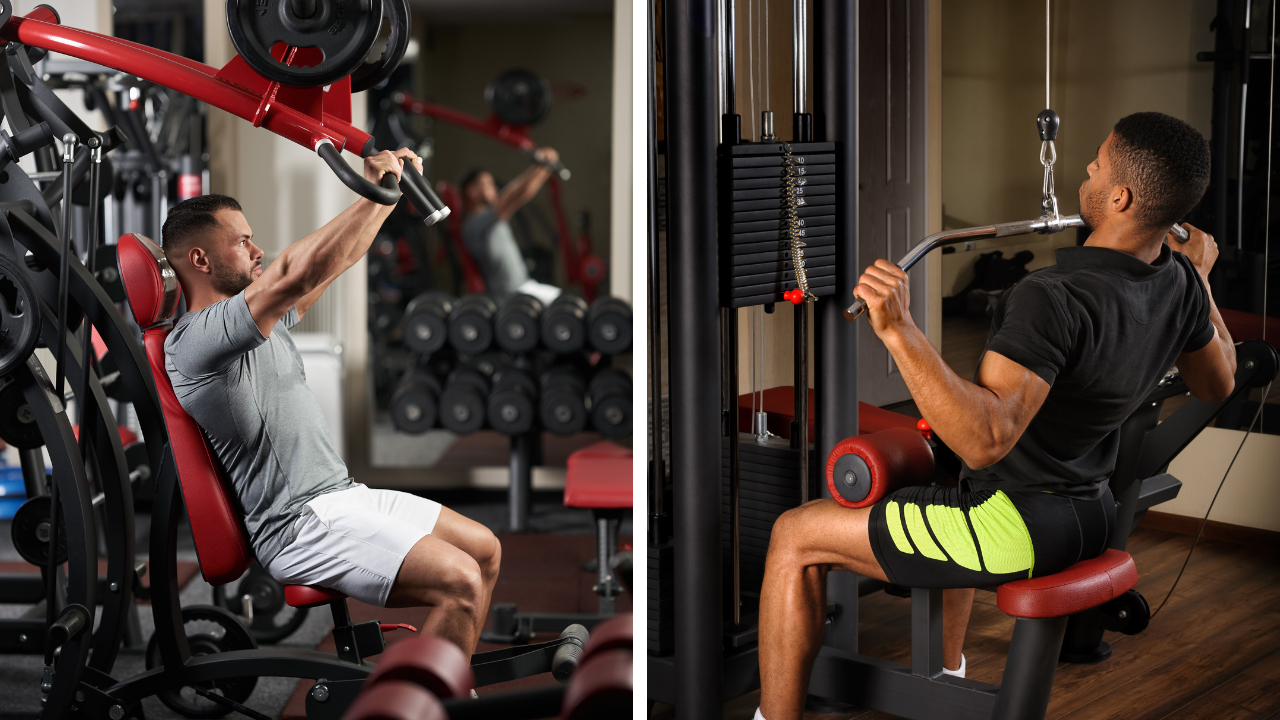
| Chest press | Lat pulldown |
The opposing muscle groups can recover during the paired movement, helping preserve performance across successive sets. A 2025 experiment involving 14 trained men adds another useful detail.
Researchers found that adding lower- or moderate-effort bench pulls after bench presses did not significantly impair bench press lifting velocity. The more demanding pairing increased blood lactate concentrations.
That finding reinforces my preference for controlled supersets with manageable fatigue.
The Problem With Chasing Exhaustion
Fitness programming has developed an unhealthy fascination with making every workout feel brutal.
I’ve seen routines that combine heavy bench presses, push-ups, and chest flyes with almost no recovery. Their apparent selling point is how difficult they are to finish. I find that approach questionable.
The 2025 meta-analysis found that supersets involving similar movement patterns could reduce total volume load.
Lack of time is consistently stated as a primary reason not to lift weights. Our recent study, led by former masters student Ryan Burke, provides evidence that agonist/antagonist supersets can substantially reduce workout duration without compromising muscle growth or strength (10.1016/j.scispo.2025.07.011).
We randomized 43 resistance-trained men and women to perform either traditional resistance training or supersets for 8 weeks. Both groups trained twice weekly, performing the same 6 exercises for 4 sets each, with sets taken to muscular failure.
The key difference was that one group performed all sets of each exercise consecutively, taking 2 min rest between sets before moving to the next exercise. Alternatively, the superset group performed two exercises targeting opposing muscle groups back-to-back, followed by 2 minutes of rest.
Results indicated similar increases in muscle thickness across all assessed muscle groups, as well as similar improvements in maximal strength, muscular endurance, and power. The total volume load was not appreciably different between conditions.
There was one key difference: Supersets reduced workout duration by 36% compared to traditional sets (~44 vs 69 mins). That’s nearly 25 mins saved per workout without appreciably compromising muscular adaptations.
The only tradeoff was that supersets produced higher perceived exertion during acute testing, although differences were much smaller when averaged across the 8-week intervention.
Collectively, our findings suggest that pairing exercises targeting opposing muscle groups is a time-efficient strategy for achieving similar gains in muscle size and strength while substantially reducing workout duration. For those with limited time to train, strategically programmed supersets offer a practical way to maximize training efficiency without compromising results. However, it’s important to note that these findings are specific to the superset configuration investigated and may not necessarily extend to other superset approaches.
https://t.co/4XnzucfQpI
— Brad Schoenfeld, PhD (@BradSchoenfeld) November 3, 2026
There is a physiological explanation: repeatedly demanding work from the same muscles accelerates local fatigue and can compromise subsequent sets.
A workout’s difficulty needs to serve a measurable training purpose. I would assess the loads, repetitions, technique, and progression before celebrating how exhausted someone feels afterward.
Rest Periods Can Change Everything

A 2022 experiment on rest intervals tested 18 recreationally trained men performing paired upper-body exercises.
Participants used one-minute, two-minute, three-minute, or self-selected recovery periods. The results showed:
- One minute: Shortest sessions, with significantly lower total training volume.
- Two minutes: A more favorable balance between duration and completed work.
- Three minutes: Greater training volume than the shorter fixed intervals.
- Self-selected rest: Performance comparable to the three-minute condition, with shorter sessions.
This is the sort of finding I wish appeared more frequently in workout advice.
Rest duration directly influences what someone can accomplish during subsequent sets. Fixed 30-second breaks make little sense as a universal prescription.
For demanding supersets, I’d begin with 90–120 seconds between completed pairs and adjust according to performance.
Heavy Strength Training Has Different Demands
The case for supersets becomes more complicated when maximal strength is the priority. A 2024 randomized controlled trial compared traditional resistance training with whole-body supersets over ten weeks.
Both groups gained strength. Conventional training produced greater improvements in lat pulldown performance, with smaller differences in other exercises.
Other research explains why preserving recovery can matter. In a 2016 eight-week training experiment, men resting three minutes between sets achieved greater improvements in squat and bench press strength than those resting one minute.
A 2024 meta-analysis on rest intervals also suggested a small muscle-growth advantage for recovery periods longer than 60 seconds. These studies establish a reasonable boundary.
For heavy squats, deadlifts, and other technically demanding exercises, I would protect recovery between challenging sets. Accessory movements provide plenty of opportunities to incorporate supersets afterward.
A Practical 40–45 Minute Strength Workout
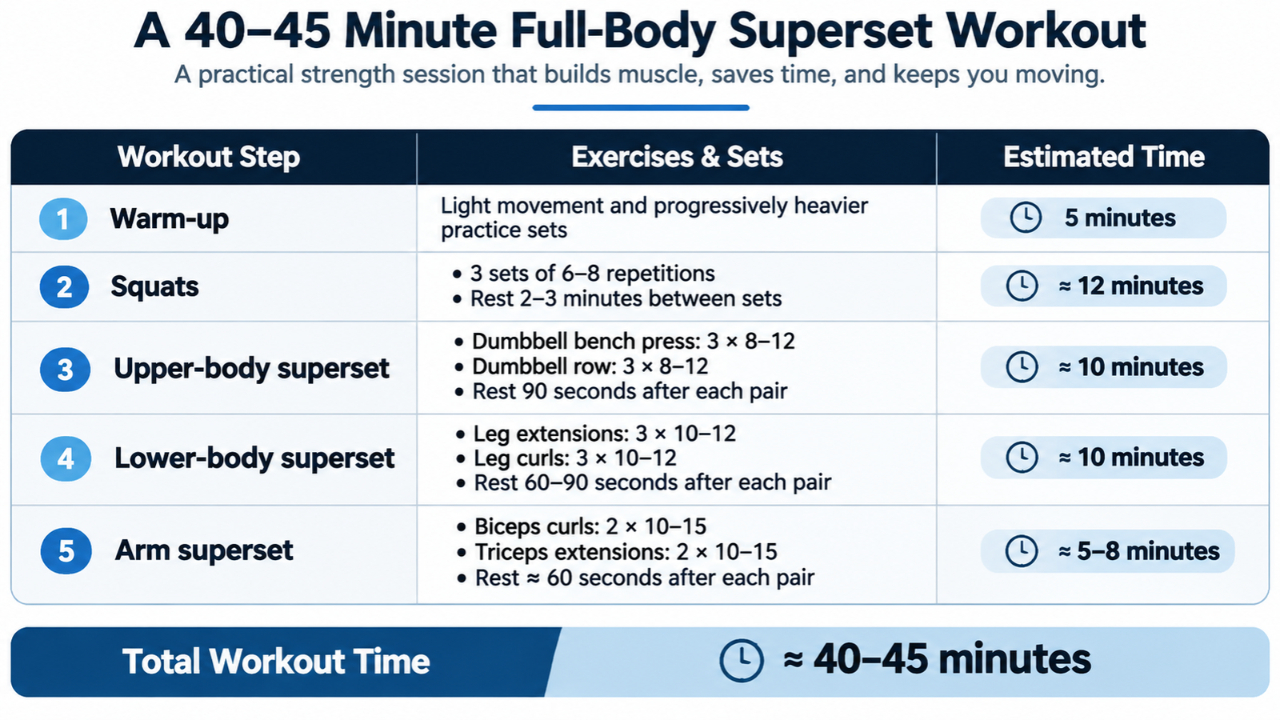
Here’s how I’d organize a full-body session for someone with previous lifting experience.
1. Warm-up – 5 minutes
Perform light movement and progressively heavier practice sets.
2. Squats – approximately 12 minutes
- Three sets of 6–8 repetitions.
- Rest two to three minutes between sets.
- Maintain consistent technique.
3. Upper-body superset – approximately 10 minutes
- Dumbbell bench press: 3 × 8–12.
- Dumbbell row: 3 × 8–12.
- Rest 90 seconds after each pair.
4. Lower-body superset – approximately 10 minutes
- Leg extensions: 3 × 10–12.
- Leg curls: 3 × 10–12.
- Rest 60–90 seconds after each pair.
5. Arm superset – approximately 5–8 minutes
- Biceps curls: 2 × 10–15.
- Triceps extensions: 2 × 10–15.
- Rest approximately 60 seconds after each pair.
The durations are estimates. Equipment availability, setup time, and personal recovery needs can extend the workout.
I’d start conservatively with the training loads and record repetitions across each session.
Your Performance Should Decide When to Rest

Supersets increase training density, and that can make them feel significantly harder.
A 2020 study comparing paired-set arrangements found that inserting 60-second breaks between opposing exercises reduced perceived exertion compared with performing the exercises consecutively, despite similar total training volume.
That’s useful evidence for anyone struggling with aggressive supersets. Three warning signs deserve attention:
- Repetitions decline sharply across successive rounds.
- Technique deteriorates as fatigue accumulates.
- Lifting loads consistently fall across workouts.
Extend recovery or change the pairing when these problems persist. I’d also advise beginners to develop reliable lifting technique before increasing training density.
The Fitness Industry Should Take Time Constraints Seriously
Our reporting on record US gym membership highlights the expanding audience for gym-based exercise.
That audience includes people managing demanding jobs, families, and limited free time.
I think fitness professionals have become far too comfortable prescribing lengthy routines without examining whether the structure is justified.
A program should account for someone’s available time, training goals, recovery capacity, and ability to follow it consistently.
Research on supersets gives coaches a strong reason to review how they organize resistance training.
The Bottom Line
@jeffnippardfitnessCut your workouts in half, without losing gains♬ original sound – Jeff Nippard
Supersets can deliver substantial time savings with comparable muscle and strength gains. Intelligent exercise pairing and adequate recovery are essential.
Every rest period deserves a purpose. Every minute of training should justify itself.