
In this report
The fitness industry keeps finding new ways to put artificial intelligence in charge of our workouts. Consumers appear considerably less enthusiastic about handing over control.
According to the 2026 Global Fitness Report from Les Mills, just 10% of more than 10,000 respondents preferred AI-created workouts over human-led experiences.
That is a remarkably small audience for a technology receiving so much attention, investment, and promotional hype. And I think fitness companies should take the result seriously.
The Survey Reveals a Clear Preference for Human-Led Fitness
The survey’s detailed results are especially revealing.
When respondents were asked about human-created versus AI-created fitness content, their preferences broke down as follows:
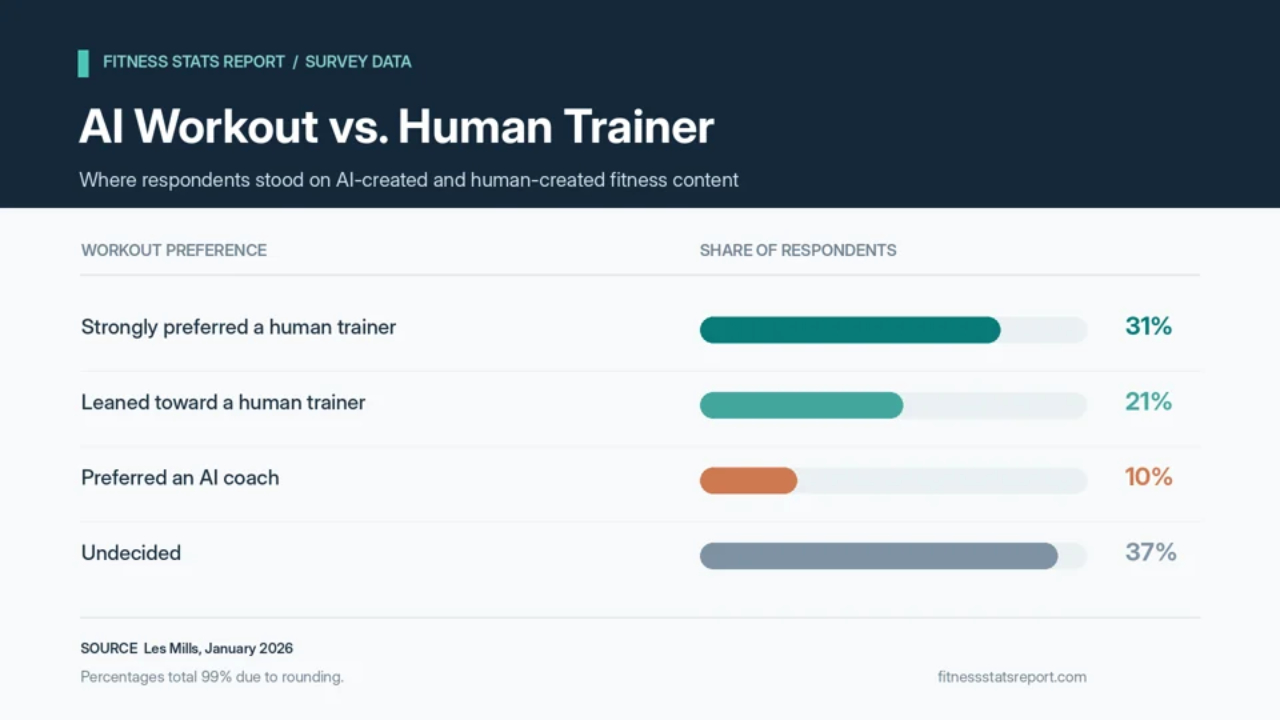
The 37% who remained undecided deserve particular attention.
Nearly four in ten respondents had yet to settle on either approach. That represents considerable room for AI adoption, especially as training platforms develop more sophisticated features.
I would be skeptical of anyone claiming this survey proves that 90% of consumers have rejected AI coaching. The numbers support a much narrower conclusion.
There is another important consideration. Les Mills sells instructor-led fitness programs and has an obvious commercial interest in emphasizing human connection. Its publicly available summary also provides limited detail about sampling and representativeness.
The findings are valuable evidence of consumer attitudes. They deserve careful interpretation.
Younger Consumers Are Surprisingly Reluctant to Choose AI
View this post on Instagram
One of the survey’s most interesting findings concerns age.
Only 11% of respondents aged 16–27 preferred AI-generated workouts. Among those aged 28–40, the figure was even lower at 9%.
Meanwhile, respondents aged 55 and older showed the highest preference for AI coaching, at 13%. That challenges a popular assumption about younger consumers.
Fitness companies routinely treat digital convenience as the defining priority of younger generations. These findings suggest that the appeal of human interaction remains substantial even among people who grew up surrounded by digital technology.
Our previous analysis of record US gym membership revealed another interesting detail: 35.5% of Americans aged 18–24 held a fitness facility membership in 2025.
Younger people are clearly willing to participate in physical fitness outside purely digital environments.
I honestly think companies designing AI-first fitness experiences around stereotypes about Gen Z are taking an unnecessary gamble.
Human Supervision Has Measurable Benefits
There is research supporting the value of having someone actively supervise a workout.
A 2025 randomized controlled trial published in the Journal of Strength and Conditioning Research compared three resistance-training approaches among 79 adults over ten weeks.
Researchers examined in-person supervision, app-guided training, and self-guided programs delivered through PDF instructions.
The differences in workout adherence were substantial:
| Training Approach | Workout Adherence |
| In-person supervision | 88.2% |
| App-guided training | 81.2% |
| Self-guided training | 52.2% |
Source: Gavanda et al., 2025; randomized trial involving 79 adults.
Participants receiving direct supervision also achieved larger squat strength improvements, averaging 26.6 kilograms compared with 19.2 kilograms in the app-guided group.
The findings offer evidence that active supervision can improve training outcomes. The researchers tested a conventional coaching app, so these findings cannot establish how modern generative AI would perform.
The importance of individual feedback becomes clear when we consider how exercise intensity differs between individuals.
A capable trainer can adjust a workout when someone struggles, recognize technical mistakes, and respond to changes in physical condition.
Those decisions have consequences for exercise quality and safety.
AI Workout Recommendations Still Have Serious Weaknesses
Artificial intelligence can produce detailed exercise programs within seconds. Their apparent sophistication deserves scrutiny.
A 2024 study published in JMIR Medical Education examined AI-generated exercise recommendations for 26 clinical populations.
Researchers found that the recommendations were only 41.2% comprehensive, although 90.7% of the evaluated information was factually accurate.
Important omissions included elements of exercise prescription and appropriate health screening.
The published research raises legitimate concerns about relying on automated recommendations for people with complex health considerations.
A broader 2026 systematic review examined 24 studies involving 2,512 participants. Safety-related problems appeared in 14 studies, including inappropriate exercise recommendations for certain clinical populations.
I find this far more concerning than whether an AI can create an impressive-looking weekly training schedule.
A program can contain sensible exercises, reasonable repetitions, and carefully calculated rest periods while overlooking information that should change the entire prescription.
Fitness companies promoting automated personalization need to demonstrate that their systems can handle those situations reliably.
The Most Useful Role for AI May Be Supporting Trainers
Professional trainers are already using artificial intelligence extensively.
An ISSA survey of 90 fitness professionals, conducted in October 2025, found that roughly eight in ten respondents used AI in their work.
Among frequent users, 89% reported improved efficiency. Across the entire sample, only 17% reported clear improvements in client outcomes.
These were self-reported findings from a small, voluntary sample, yet the distinction is worth examining.
AI can help prepare workout templates, organize training records, summarize information, and handle administrative work.
Consumer fitness technology already demonstrates the value of automated feedback.
As explored in our report on fitness tracker ownership, 46% of American adults reported owning wearable technology in a recent Rock Health survey.
Meanwhile, Peloton’s latest treadmill technology includes personalized pacing recommendations and movement-analysis features.
These developments give exercisers more information about their performance.
I welcome tools that make useful feedback more accessible. I would also like to see stronger evidence that automated recommendations consistently improve long-term exercise outcomes.
That is where the fitness technology industry needs to direct more of its research investment.
The Fitness Industry Must Earn Its Human Advantage

Les Mills also found that 41% of respondents considered exercise a chore. Among people interested in beginning strength training, 50% felt intimidated by the weights area, while 54% struggled with conflicting advice.
Those are practical problems that skilled instructors can help solve.
Still, human-led exercise should face rigorous evaluation.
A 2026 meta-analysis of 71 studies found no statistically significant overall advantage of group-based interventions over individual approaches for increasing physical activity.
That finding deserves attention, especially when group fitness companies promote the superiority of communal exercise experiences.
A crowded studio and an energetic instructor do not guarantee better results.
Effective coaching requires appropriate exercise selection, clear instruction, individual attention, and a program people can sustain.
I think gyms should spend considerably more effort improving those fundamentals.
An instructor who remembers someone’s limitations, recognizes their progress, and helps them feel comfortable exercising is delivering genuine value.
A poorly prepared instructor reading generic instructions has a much weaker case for charging a premium.
The emergence of increasingly sophisticated AI workout tools makes that distinction even more important.
Human-Led Fitness Has an Opportunity Worth Protecting
@josiedavis.fit I’ve gotten an asked several times if I’m worried about AI replacing my job. But if you are hiring a fitness coach, who only sends you workouts and macros, you are probably wasting your money find someone who connects to you on a human level. #personaltrainer #fitness #fitnesscoach #womenshealth #gymtok ♬ original sound – josiedavis.fit
The 10% preference for AI workouts is a meaningful finding. Consumers still place substantial value on expertise, encouragement, and personal interaction.
I expect AI coaching to become more capable and more widely available. Consumer preferences may change with it.
For now, fitness businesses have a clear opportunity to demonstrate the value of human expertise through better instruction and measurable results.
The industry should be obsessed with earning that trust. Its continued preference among consumers deserves more than another marketing campaign about the human touch.