

In this report
A treadmill speed is a terrible judge of how hard someone is exercising. Yet fitness advice keeps treating walking speeds, cycling speeds, and heart-rate zones as though they mean the same thing for everyone.
Put two people on stationary bikes at identical resistance settings. One might comfortably hold a conversation for 30 minutes. The other could be breathing heavily after five.
They completed the same workout on paper. Their bodies experienced two very different workouts.
This is one of my biggest frustrations with generic fitness advice. We have become obsessed with assigning intensity labels to activities while paying remarkably little attention to the people performing them.
And the science is clear: exercise intensity depends heavily on the individual doing the exercise.
That should fundamentally change how we prescribe workouts, interpret fitness statistics, and judge whether someone is exercising hard enough.
The Problem With Calling an Activity “Moderate”

The CDC’s exercise intensity guidance lists brisk walking, recreational swimming, and cycling below 10 miles per hour among common examples of moderate-intensity activities.
Running, swimming laps, and faster cycling generally fall into the vigorous category.
Those descriptions are useful for explaining physical activity to large populations. They become considerably less reliable when applied to individuals.
Consider walking at three miles per hour. For a reasonably fit adult who walks several miles daily, that pace might feel comfortable. Someone returning to exercise after years of inactivity could experience substantial cardiovascular strain at the same speed.
A person with significant mobility limitations might struggle to sustain it for five minutes. There is no scientific justification for pretending these experiences are physiologically equivalent.
The CDC explicitly recognizes that an activity considered vigorous for someone of average fitness may only be moderate for a very fit individual.
I think this point deserves far more attention than it receives, especially in beginner exercise programs.
The Numbers Explain Why Intensity Gets Misclassified
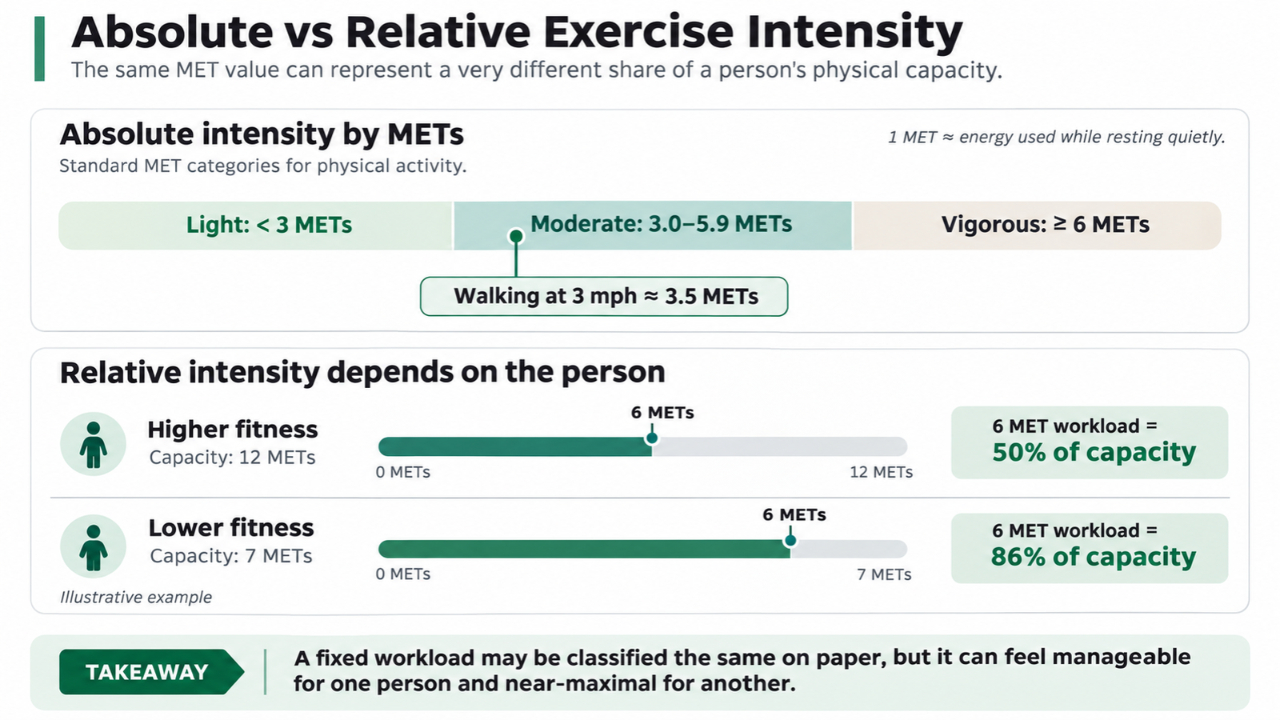
Exercise scientists commonly distinguish between absolute and relative intensity.
Absolute intensity measures the energy required to perform an activity, usually expressed in metabolic equivalents, or METs.
Under the federal physical activity guidelines:
- Light activity requires fewer than 3 METs.
- Moderate activity requires 3.0 to 5.9 METs.
- Vigorous activity requires at least 6 METs.
One MET represents approximately the energy expenditure of resting quietly.
Walking at three miles per hour is typically assigned approximately 3.5 METs, placing it in the moderate category under the standard absolute classification. These numbers provide researchers with a standardized way to compare activities.
Relative intensity accounts for how demanding an activity is for a particular person, given their fitness and physiological capacity. This distinction has enormous implications.
An activity requiring six METs could represent a manageable aerobic session for someone with excellent cardiovascular fitness. For someone with substantially lower aerobic capacity, the same workload could approach their personal limits.
A 2025 ACSM and ESSA expert consensus statement directly addressed this problem, warning that fixed intensity classifications can produce substantially different physiological demands across individuals.
I find that conclusion particularly important because fitness programs still routinely prescribe the same percentages, speeds, and workloads to people with very different capabilities.
Your Heart-Rate Zone Is Not Everyone Else’s Zone
Heart-rate monitors have made exercise intensity look wonderfully precise. Your watch displays a number, assigns a colored zone, and tells you how hard you worked.
Unfortunately, those colored zones can create more confidence than the underlying measurements deserve.
Two people exercising at 140 beats per minute may be operating at very different percentages of their cardiovascular capacity.
Maximum heart rate varies between individuals. Resting heart rate varies. Fitness, medications, and health conditions also influence the relationship between heart rate and exertion.
Even widely used formulas estimating maximum heart rate from age provide population-level approximations.
The problem becomes particularly obvious with beta blockers, medications that reduce heart rate. The American Heart Association explains that people taking these medications may need individually adjusted exercise targets.
View this post on Instagram
Meanwhile, as discussed in our report on American fitness tracker ownership, wearable devices are becoming increasingly common.
I welcome the growth of exercise tracking. Long-term heart-rate trends and workout records can be genuinely useful.
What concerns me is the authority people give to automatically generated intensity labels. A smartwatch can estimate your training zone using available measurements and algorithms. That classification still deserves scrutiny.
I would be extremely reluctant to let a default watch setting overrule clear evidence from someone’s actual physical response.
The Talk Test Deserves More Respect
One of the most practical methods for judging aerobic exercise intensity requires absolutely no technology. The CDC recommends the talk test.
During moderate-intensity aerobic exercise, you should generally be able to speak comfortably enough to maintain a conversation, although singing becomes difficult.
During vigorous activity, speaking more than a few words usually requires pausing to breathe.
The CDC also recommends a perceived-exertion scale from zero to ten.
Moderate relative intensity generally corresponds to about five or six. Vigorous intensity begins around seven or eight.
These are useful tools because they reflect the effort the person is experiencing.
I particularly like perceived exertion for ordinary walking and jogging.
Some days, my usual route feels effortless. On others, the hills demand considerably more attention. Sleep, fatigue, temperature, and accumulated training all influence how exercise feels.
The pace alone cannot describe every session.
Perceived exertion has limitations, of course, and clinical exercise testing can provide more precise physiological measurements. For everyday aerobic activity, these simple checks offer information that fixed speed targets frequently miss.
Fitness Improvements Change the Meaning of Your Workout

There is another implication that deserves attention. A workout can gradually become less intense as your fitness improves, even when every external measurement stays identical.
Imagine someone beginning a walking program at three miles per hour. Initially, they rate the effort seven out of ten.
After several months of consistent training, they complete the same route at the same speed and report an effort of four.
That change is a positive adaptation. Their cardiovascular system can now handle the workload more comfortably.
If their objective is continued cardiovascular conditioning, they may eventually need to increase their walking speed, introduce hills, or extend their sessions.
This principle also matters when interpreting research about walking intensity.
Our analysis of a large study comparing brisk and slower walking examined how walking cadence and total daily steps were associated with mortality risk.
Walking speed can provide valuable population-level information. Individual capacity remains important when translating those findings into exercise advice. A useful training prescription has to evolve with the person following it.
Physical Activity Guidelines Need Individual Interpretation
Current U.S. recommendations call for at least 150 minutes of moderate-intensity aerobic activity weekly, or 75 minutes of vigorous activity, alongside muscle-strengthening exercise on two days.
Sharks keep moving. Your body benefits when you do, too.
Adults should aim for at least 150 minutes of moderate-intensity physical activity each week, plus muscle-strengthening activities on 2 or more days each week.
Regular physical activity can help reduce your risk of chronic diseases, including heart disease, type 2 diabetes, and some cancers, while improving your overall health and well-being.
Every minute counts. Choose one way to move today: Take a walk, ride a bike, dance, or do another activity you enjoy and build toward your weekly goal.
#SharkWeek #ChronicDisease #GetActive— CDC (@CDCgov) July 29, 2026
Those recommendations provide an important public-health benchmark.
As we explored in our article about exercise guidelines and cardiovascular protection, the relationship between physical activity and health benefits extends across a broad range of weekly exercise volumes.
Intensity adds another layer of complexity.
Two adults might each report 150 minutes of brisk walking per week while experiencing substantially different levels of physiological exertion.
This creates challenges for population surveys, wearable algorithms, and researchers attempting to compare exercise behavior.
It also creates an opportunity to improve how we communicate physical activity recommendations.
I would like to see far fewer universal prescriptions based on arbitrary treadmill speeds and far more guidance that teaches people to recognize effort.
That would make exercise advice more useful for beginners, older adults, people managing physical limitations, and experienced athletes.
We Need to Stop Grading Exercise by Someone Else’s Fitness

I find it particularly irritating when people dismiss walking or other accessible activities as insufficiently demanding exercise.
For someone rebuilding cardiovascular fitness, a sustained walk could represent a genuinely challenging workout. That effort deserves recognition.
Equally, an experienced runner completing an easy jog should understand that the session may provide a relatively modest training stimulus despite covering considerable distance.
Both people benefit from evaluating exercise according to their own capabilities and goals. The same principle should guide fitness instructors, personal trainers, health professionals, and anyone designing exercise programs.
People deserve workouts that challenge them appropriately, progress as their fitness improves, and respect their individual limitations. Exercise intensity belongs to the person performing the exercise.
Once we take that principle seriously, much of the confusion surrounding moderate and vigorous exercise becomes easier to resolve.
And perhaps we can finally retire the idea that a treadmill setting knows more about your workout than your own cardiovascular system does.