
In this report
Wearable fitness technology has crossed the line from enthusiast gadget to ordinary consumer technology.
In Rock Health’s latest consumer adoption survey, 46% of U.S. adults said they owned a wearable device, up from just 13% in 2015.
Smartwatches dominate the category, with roughly four in ten adults reporting ownership. The survey included 8,000 U.S. adults matched to Census demographics and was conducted in December 2025.
So, technically, we are a few percentage points short of a literal one in two. I think “one in two” is a fair description of where the market has arrived, provided we do not quietly turn 46% into 50% and call them the same number. They aren’t.
The more interesting story, anyway, is not whether we can round up four percentage points. It is that something that barely existed in its current form a decade ago is now sitting on the wrists, fingers, and nightstands of nearly half the adult population.
And people are actually using the devices.
Wearable Ownership Has Climbed Dramatically Since 2015
Rock Health reports that wearable ownership increased from 13% of U.S. adults in 2015 to 46% in 2025, a 33-percentage-point increase in ten years. That is a substantial shift.
Yet one detail in the report caught my attention more than the decade-long growth figure. Adoption has flattened in recent years.
Rock Health was already reporting 46% wearable ownership in 2022. In other words, the category made enormous progress during its earlier years, but it has not simply marched upward until everybody owns one. The company’s 2022 digital health survey provides the useful comparison.
I find that much more informative than another prediction that every human being will eventually be wearing six sensors and receiving a recovery score before breakfast.
There appears to be a large group of Americans who really like wearable technology and another substantial group who remain unconvinced they need it.
That is normal. Not every useful technology needs 100% adoption.
Different Surveys Give Slightly Different Numbers
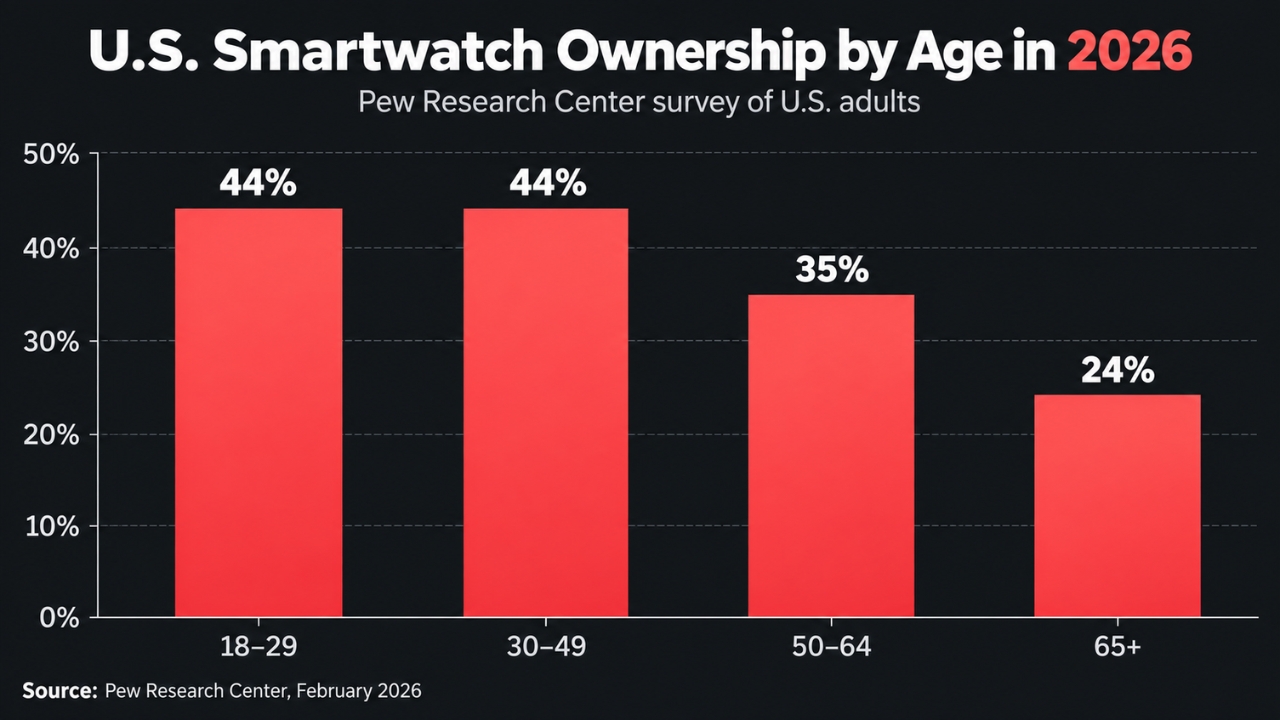
Pew Research Center provides a useful comparison. In a February 2026 survey of 5,119 U.S. adults, 37% said they had a smartwatch, according to Pew’s smartwatch ownership data.
Ownership reached 44% among adults ages 18–29 and 44% among those ages 30–49. It fell to 35% among adults ages 50–64 and 24% among those 65 and older.
Rock Health puts smartwatch ownership somewhat higher. I do not see that as evidence that somebody got the numbers wrong.
The surveys use different samples, wording, definitions, and methodology. Rock Health also uses a broader wearable category that includes smart rings.
After years of looking at survey data, I’ve learned that two percentages measuring something that sounds similar are not necessarily measuring exactly the same thing.
That is particularly important with technology categories, where the definition itself keeps changing.
A Fitbit, Apple Watch, Garmin, Oura Ring, and increasingly sophisticated health sensor can all fit somewhere under the wearable umbrella. The umbrella is getting crowded.
Owners Are Actually Wearing Their Devices
Ownership statistics can exaggerate the importance of consumer products. Plenty of us own exercise equipment that has enjoyed a long and productive second career as furniture. Wearables look different.
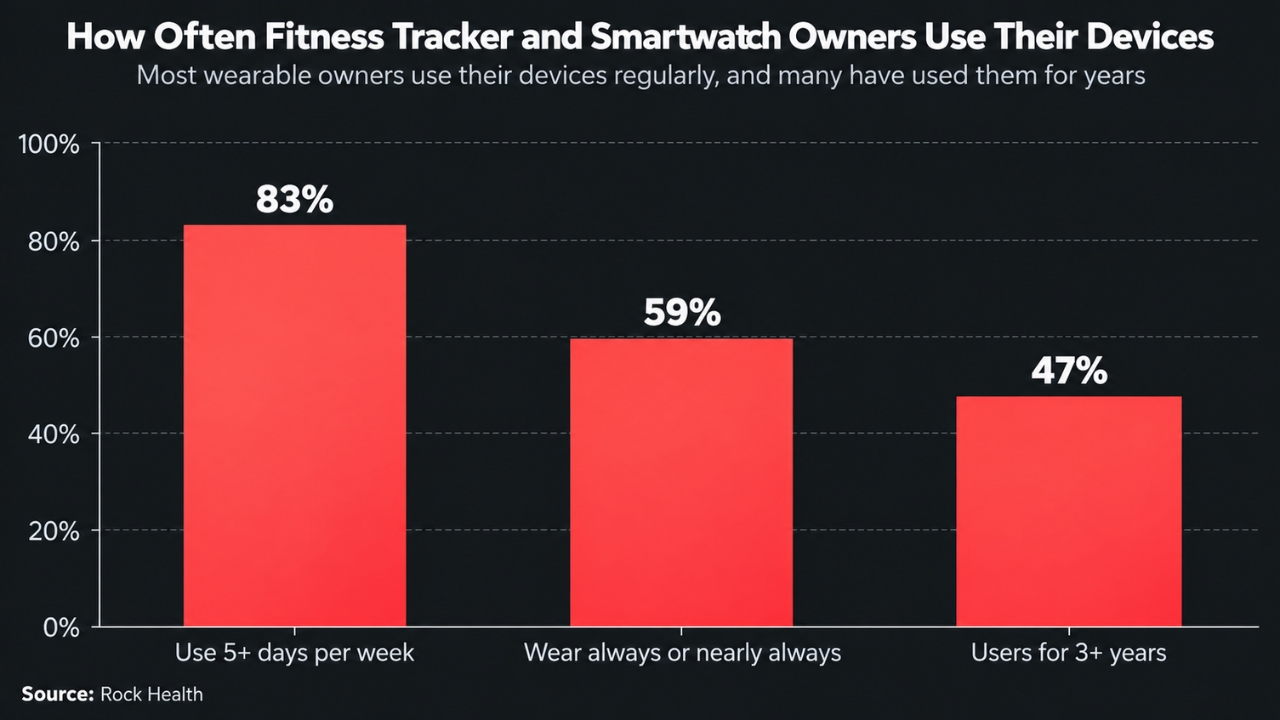
Rock Health found that 83% of wearable owners use their devices at least five days per week, and 59% wear them always or nearly always, apart from situations such as charging. Nearly half, 47%, have been wearable users for at least three years.
To me, that is stronger evidence of wearables becoming mainstream than the 46% ownership figure.
Buying something is easy. Building it into your routine for several years is much harder.
There is also substantial brand loyalty. Among wearable owners, 48% were still using the same wearable brand they started with, and another 27% had upgraded to a newer model from that same brand. Only 23% had switched brands.
Once several years of steps, workouts, heart-rate trends, and sleep history accumulate inside one ecosystem, switching becomes more annoying than changing watches. Your wrist now has data lock-in.
Americans Are Tracking Much More Than Steps
View this post on Instagram
The old fitness tracker was basically a fancy pedometer. Modern wearables can monitor heart rate, sleep, workouts, breathing, recovery estimates, temperature trends, blood oxygen measures, and increasingly complicated scores generated from several signals at once.
Wearable data is also moving directly into connected fitness platforms such as Peloton, where heart-rate data can now shape workouts and pace targets.
In Rock Health’s survey, physical activity was the leading tracked category at 35%, followed by sleep at 26% and heart rate at 21%.
I think that progression explains a good part of wearable technology’s staying power.
Steps are useful, but there are only so many ways a device can tell you that you walked 7,846 of them.
The more interesting development has been turning several days or months of measurements into trends. A single resting heart-rate reading tells you relatively little. Watching how that number behaves over six months is potentially much more informative.
Still, I would resist the temptation to treat every number produced by a wearable as a laboratory measurement.
Consumer wearables are generally much better at some measurements than others. A systematic review of wearable accuracy found reasonable performance for measures such as steps and heart rate in many devices, with energy-expenditure estimates considerably less dependable.
Your watch can be useful without being infallible. Those two ideas coexist quite happily.
Automated fitness recommendations face a similar challenge. Our report on AI workout preferences found that just 10% of surveyed respondents favored AI-created workouts over human-led exercise.
Does Wearing a Fitness Tracker Actually Make People More Active?
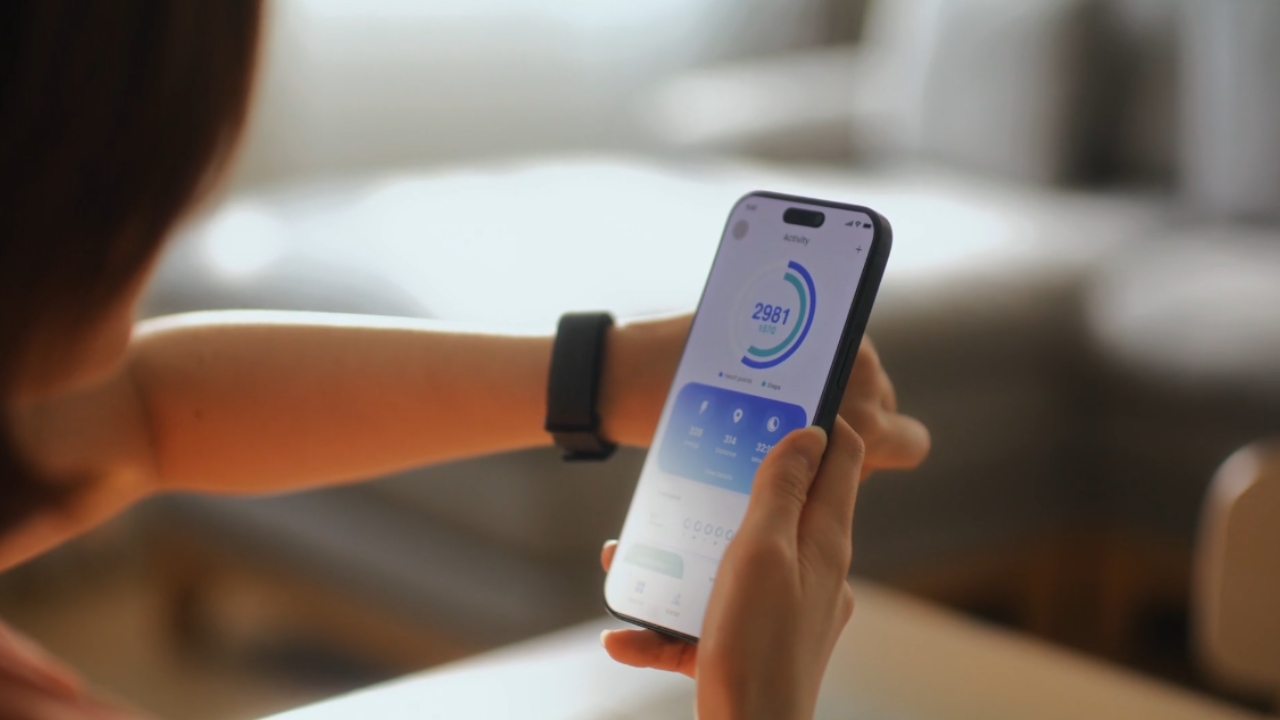
Here is where I think the conversation gets more interesting. Nearly half of adults owning wearables does not mean wearables have caused half the country to become more active.
People who already care about exercise are more likely to buy devices that measure exercise. That selection effect matters.
Rock Health found that device ownership continues to skew toward people who are younger, wealthier, more urban, healthier, and more likely to have commercial insurance.
So we cannot look at wearable owners, notice that many exercise, and conclude the watch caused the behavior.
The same caution applies to gym membership and physical activity, since gym members are far more active but membership alone does not prove cause and effect.
There is, however, legitimate evidence that activity trackers can help.
A large umbrella review published in The Lancet Digital Health examined 39 systematic reviews involving more than 163,000 participants.
Across the included research, wearable activity-tracker interventions increased physical activity by an amount equivalent to roughly 1,800 additional steps per day, about 40 extra minutes of walking, and around six additional minutes of moderate-to-vigorous activity per day, according to the wearable intervention review.
I consider that meaningful. It is also much less dramatic than the way fitness technology is sometimes marketed.
A tracker does not magically make somebody fit. What it can do is provide feedback, reminders, goals, and a visible record of behavior. For some people, seeing 4,200 steps at 7 p.m. is enough of a nudge to go outside for another walk.
My Labrador achieves the same effect without Bluetooth.
Nearly Half Own Wearables, but That Does Not Mean Nearly Half Are Fit
There is an interesting numerical coincidence in the latest data.
Rock Health reports 46% wearable ownership. Separately, CDC data for 2024 show that 47.2% of U.S. adults met the federal aerobic physical activity guideline.
That broader gap becomes even clearer in the latest data on America’s falling inactivity rate, where participation looks far stronger than compliance with the full exercise guidelines.
A new CDC report shows fewer than half of U.S. adults met aerobic exercise guidelines in 2024, raising concerns about long-term health impacts. https://t.co/OWwV47yvSS https://t.co/J8b96mNy9U
— ABC30 Fresno (@ABC30) April 22, 2026
Those numbers are remarkably close.
They should absolutely not be interpreted as the same people.
The CDC statistic comes from the National Health Interview Survey and measures whether adults reported enough leisure-time aerobic activity to meet federal guidelines. Wearable ownership comes from a different survey asking about technology.
I mention the comparison because it illustrates a mistake that is very easy to make with fitness statistics. Two numbers line up beautifully, so our brains immediately want them to be related.
Data does not owe us a neat story.
More importantly, basic exercise guidelines for heart health are only one benchmark for how much physical activity may benefit the body.
Earlier CDC data found that a substantially smaller share of adults met both aerobic and muscle-strengthening guidelines. A smartwatch can count your afternoon walk very nicely. It still cannot do your squats for you.
For people who want more efficient strength sessions, a 40–45 minute superset workout offers one way to complete several muscle-group exercises in less time.
Wearables Also Reflect an Access Gap
Another part of the Rock Health findings deserves more attention.
Device ownership is higher among people who are younger, wealthier, healthier, and more urban. People reporting poorer health are less likely to own these devices. That creates an awkward situation.
The people producing the richest streams of wearable health data are not necessarily the populations that would benefit most from better long-term health monitoring.
I think this becomes increasingly important as wearable data moves beyond personal fitness apps and into healthcare, research, and algorithmic health recommendations.
A dataset containing millions of measurements can look incredibly powerful. If those measurements disproportionately come from healthier, wealthier, younger users, however, the dataset still has a representation problem.
More data does not automatically mean representative data.
Wearable Data Is Already Entering the Doctor’s Office
Wearables are also becoming harder to classify as simple fitness products.
Rock Health found that 59% of wearable owners have discussed their wearable data with a healthcare provider. Thirty percent said they do so regularly, another 29% had done so at least once, and 20% had not yet discussed the data with a clinician but wanted to.
To me, that may be the biggest long-term story in the entire survey.
Counting steps is one thing. Bringing months of heart-rate, sleep, activity, or rhythm data into a medical appointment is something else entirely.
There are obvious challenges. Consumer measurements need appropriate interpretation, healthcare systems have to decide which data are useful, and clinicians cannot realistically inspect an endless stream of every patient’s daily metrics.
Still, wearable technology has something traditional healthcare rarely has: repeated measurements collected during ordinary life rather than a brief snapshot inside a clinic.
That does not automatically make the information clinically valuable. It does make it interesting.
Wearables Have Won the Adoption Battle
Ten years ago, the big question was whether ordinary people would keep wearing fitness trackers after the novelty wore off. We have an answer.
Nearly half of U.S. adults now own a wearable, more than eight in ten owners wear theirs at least five days a week, and many have remained with the category for years. Wearables are no longer niche fitness accessories.
I think the next question is harder – What are we actually getting from all this measurement?
There is good evidence that trackers can encourage additional activity. There is growing potential for longer-term health monitoring. There are also limitations involving accuracy, access, privacy, interpretation, and the basic fact that measuring behavior is not the same thing as changing it.
We have become very good at knowing how many steps we took yesterday.
Figuring out what to do with everything else our wrists know about us will be the more interesting part.