

In this report
If you exercise for 150 minutes a week, you are doing something meaningful for your health. New research suggests that substantially greater protection against cardiovascular disease could require a lot more movement, somewhere around 560 to 610 minutes of moderate-to-vigorous physical activity per week.
Yes, that is roughly nine to ten hours.
Before anyone starts reorganizing their entire life around two-hour treadmill sessions, the details matter.
Researchers analyzing 17,088 adults found that meeting the commonly cited 150-minute weekly exercise target was associated with an 8% to 9% lower risk of cardiovascular events.
Getting into the 560-to-610-minute range was associated with a risk reduction of more than 30%, according to the British Journal of Sports Medicine study.
I find the dose-response pattern much more interesting than the headline claim that we suddenly need four times as much exercise.
The data do suggest that more activity was associated with substantially greater cardiovascular protection. They do not show that 150 minutes has somehow become useless.
That distinction matters quite a bit.
What the Researchers Actually Measured
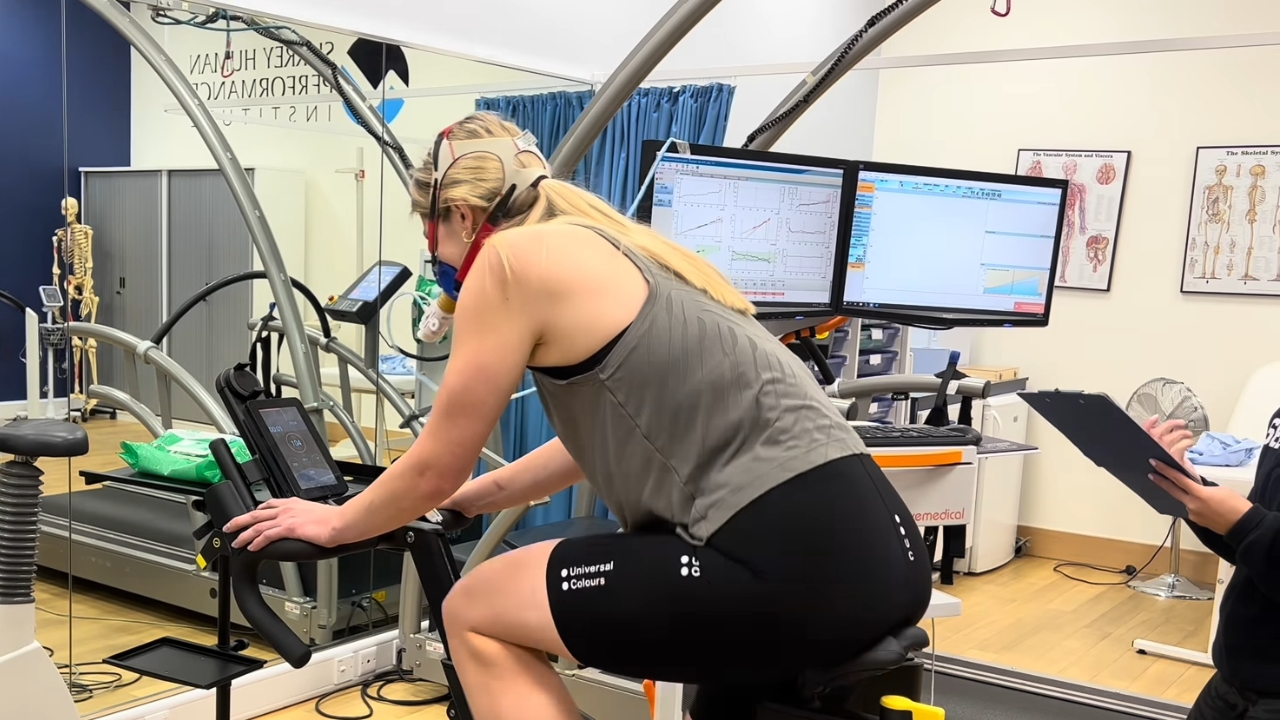
The research, published in the British Journal of Sports Medicine, used data from UK Biobank participants who had been assessed between 2013 and 2015.
The average participant was 57 years old. About 56% were women, and 96% were white. Participants wore wrist-based activity monitors for seven consecutive days, giving researchers an objective measure of activity rather than relying entirely on people to remember how much they exercised.
They also completed a cycling test that researchers used to estimate cardiorespiratory fitness, expressed through VO2 max.
That measurement approach immediately gets my attention.
After years of looking at physical-activity research, one of the first questions I ask is whether exercise was actually measured or simply reported by participants. People are remarkably creative historians when asked how active they were last Tuesday.
Device data are not perfect, though they remove a major source of uncertainty.
Researchers followed participants for a median of about 7.8 years. During that period, 1,233 cardiovascular events occurred, including 874 cases of atrial fibrillation, 156 heart attacks, 111 cases of heart failure, and 92 strokes. The ScienceDaily report provides a useful overview of those findings.
The Numbers Make More Sense When You Put Them Side by Side
The relationship between weekly activity and cardiovascular risk did not suddenly appear at 600 minutes.
Risk fell progressively as activity increased.
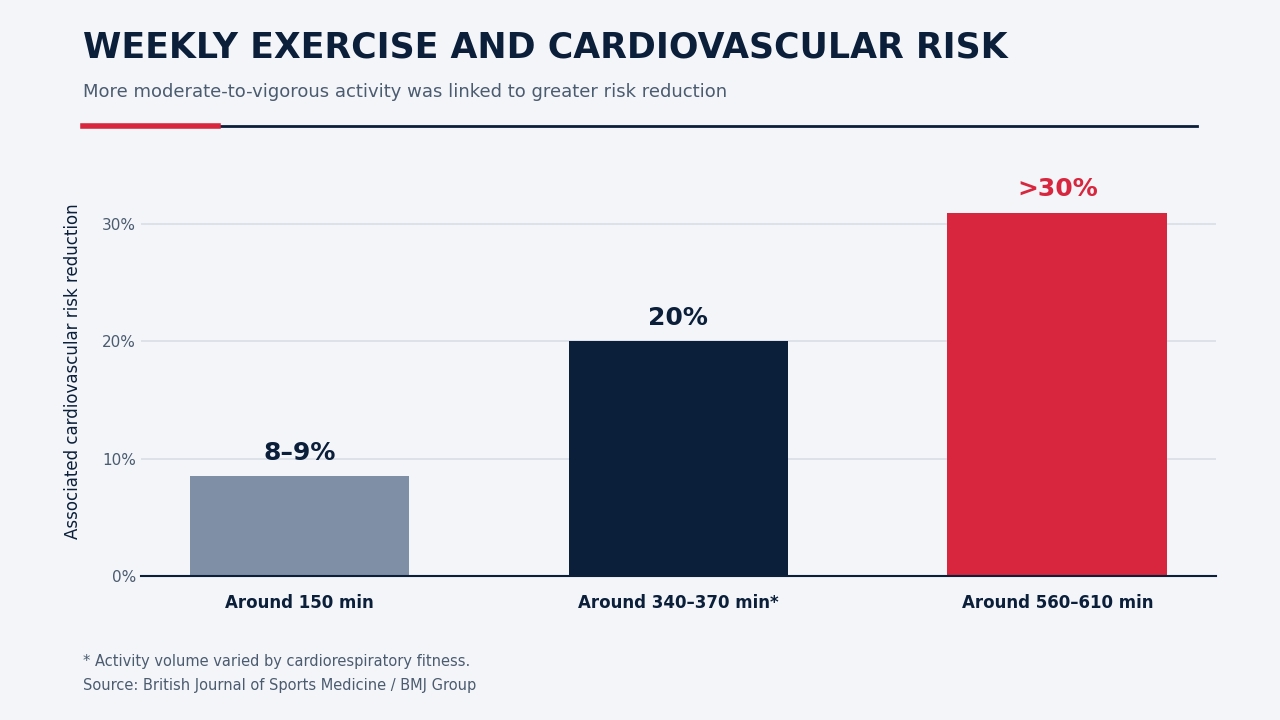
Only about 12% of participants accumulated enough moderate-to-vigorous activity to reach the 560-to-610-minute range, as detailed in the BMJ Group study summary.
That last statistic deserves some attention.
A recommendation can look excellent on a dose-response curve and still be difficult to turn into population-level behavior. At the population level, there has been some progress: the U.S. inactivity rate has fallen to 18.7%, its lowest level on record.
That challenge starts early, as recent CDC data also show a decline in physical activity among U.S. teens.
Nine hours of moderate-to-vigorous activity every week is a very different proposition from walking briskly for 30 minutes on five days.
“Four Times the Guidelines” Is a Little Too Neat
The four-times figure comes from comparing roughly 600 minutes with the familiar 150-minute minimum.
Public-health recommendations are broader than that.
Current U.S. physical activity guidance recommends 150 to 300 minutes of moderate-intensity aerobic activity per week, along with muscle-strengthening work on at least two days.
Wondering how much physical activity you need? For adults, aim for:
🚶♀️ Moderate-intensity activity (like brisk walking) for 150 minutes/week.
💪 Muscle-strengthening activities (like lifting weights) at least 2 days/week.
If that feels like a lot, start with just one walk, one class, or one active choice today.
It all adds up.
#StartWithOne #MoveMoreFeelBetter #PhysicalActivityForAdults
— CDC (@CDCgov) May 1, 2026
WHO recommendations use the same 150-to-300-minute range for moderate activity, or 75 to 150 minutes of vigorous exercise. Both recognize that going beyond those amounts can provide additional benefits.
So 600 minutes is approximately four times 150 minutes. It is closer to twice 300 minutes.
I know that sounds like number-picking, yet it changes how the story feels.
“Scientists discover we need four times more exercise” makes existing recommendations sound badly wrong.
The evidence says something more reasonable: the minimum associated with meaningful health benefits appears considerably lower than the amount associated with the greatest cardiovascular risk reductions in the new analysis.
Public-health guidelines have always had to balance biological benefit with what people can realistically achieve.
Fitness Level Changed How Much Activity People Needed
One of the more interesting parts of the research involved cardiorespiratory fitness.
Researchers divided participants according to fitness and found that less-fit people generally needed somewhat more physical activity to reach the same estimated cardiovascular benefit as fitter people.
For a 20% reduction in cardiovascular risk, people in the lowest fitness group needed around 370 minutes per week of moderate-to-vigorous activity. Those in the highest fitness group needed approximately 340 minutes.
View this post on Instagram
The difference is meaningful, though hardly enormous.
I would be careful about turning it into another personalized exercise formula. Cardiorespiratory fitness reflects genetics, long-term activity patterns, age, health, and other factors. VO2 max was also estimated here rather than measured directly through maximal laboratory testing.
The broader idea is more useful: exercise volume and fitness are related, yet they are not interchangeable measurements.
The distinction becomes even clearer when we consider why the same workout can feel moderate for one person and vigorous for another.
A person can accumulate quite a lot of physical activity and still have lower cardiorespiratory fitness than someone else.
The Study Cannot Tell Us That 600 Minutes Causes a 30% Risk Reduction

Here is where I put my epidemiology hat on.
The research was observational.
Researchers adjusted for factors including smoking, alcohol consumption, diet, body mass index, resting heart rate, and blood pressure. That strengthens the analysis. It cannot remove every difference between highly active people and less-active people.
People who exercise nine or ten hours each week could differ in ways that are difficult to measure completely. Health status, occupational activity, socioeconomic factors, and long-term lifestyle patterns can all enter the picture.
The researchers also acknowledged that UK Biobank participants tend to be healthier than the general population. The sample was overwhelmingly white, which limits how confidently the exact numbers can be applied across populations.
Fitness was estimated, and lower-intensity activity and sedentary time were not included in the primary exercise measure.
Another issue catches my eye: activity was recorded for seven days.
A week of accelerometer data is much better than asking someone to reconstruct months of exercise from memory. Seven days still represent a snapshot.
Consumer devices collect far more continuous data now, especially as fitness trackers and smartwatches have become mainstream, but that does not make every wearable measurement equivalent to research-grade data.
Human exercise habits have an annoying tendency to change over seven or eight years.
None of those limitations makes the results unimportant. They tell us how precisely to interpret them.
I Would Not Turn 600 Minutes Into the New Magic Number
Fitness culture loves thresholds.
Ten thousand steps. Thirty-minute workouts. Five training days. Zone 2 for a particular number of minutes. Now we have the possibility of 600 minutes for heart health.
Biology rarely behaves that neatly.
The dose-response relationship in the research is the real story. People doing more moderate-to-vigorous activity generally had lower cardiovascular risk, and benefits continued well beyond 150 minutes.
Other research has pointed in the same general direction. Large prospective cohort data have previously found lower cardiovascular mortality among adults performing roughly two to four times the minimum recommended amount of moderate activity, a pattern discussed by the American Medical Association.
So I am persuaded by the idea that 150 minutes should be viewed as a useful floor rather than an ideal ceiling.
I am much less persuaded that everyone should leave the research believing that 600 minutes is now the correct weekly prescription.
Nine Hours of Exercise Also Looks Different in Real Life

Six hundred minutes sounds intimidating because most people picture organized workouts.
It does not necessarily mean ten hours inside a gym.
Indoor cardio also has more options now, with new Peloton treadmills built around pace targets, heart-rate zones, and run analysis.
Moderate activity can include brisk walking, cycling, and other activities that noticeably increase breathing and heart rate.
Someone who walks briskly for transportation, cycles regularly, hikes on weekends, and exercises a few times during the week can accumulate substantial volume without scheduling ten separate hours of formal training.
Still, 560 to 610 minutes is roughly 80 to 87 minutes every day.
For someone working long hours, caring for children, managing health problems, or living somewhere where walking and cycling are difficult, that is a major time commitment.
Physical-activity recommendations cannot ignore that reality.
Telling an inactive person that optimal cardiovascular protection requires ten hours of weekly exercise could easily make 150 minutes feel pointless. The study provides the opposite message.
The first 150 minutes mattered.
More appeared to matter more.
My Takeaway: Think in Ranges, Not Pass-Fail Targets
@bruce.billy92The Importance of Regular Exercise | Protect The Heart♬ original sound – Bruce Billy
I would interpret the new research as evidence for a continuum of cardiovascular benefit.
Getting to 150 minutes remains worthwhile. Moving closer to 300 minutes appears better. People who enjoy exercise, tolerate higher training volumes well, and can fit more activity into their lives could gain further cardiovascular benefit by continuing beyond that point.
Some people will reach 600 minutes. Many will not.
Public-health recommendations work best when people see them as a starting framework rather than an exam where 149 minutes earns an F and 600 earns an A.
The most useful lesson from the research is pleasantly simple: the cardiovascular payoff from physical activity does not appear to stop once you hit the minimum recommendation.
I have never found that particularly surprising. What makes the new research valuable is that it gives us a better idea of how far the dose-response relationship might extend, and reminds us that “enough to help” and “the amount associated with the greatest benefit” are two very different questions.