
In this report
A timed mile can tell us how fast a student runs. It cannot tell us whether that student has regular physical education, somewhere safe to exercise after school, or anyone showing them how to improve.
That distinction is important now that the Presidential Fitness Test is making its way back into American schools.
President Donald Trump ordered its reinstatement in July 2025. The Department of Health and Human Services officially relaunched the program in June 2026, and schools are beginning to introduce updated fitness assessments.
The government has also announced a $10 million competition to encourage schools and youth organizations to adopt the test.
I support measuring physical fitness. My concern is that we’re reviving a familiar measuring tool in a school system where opportunities to become physically fit have been shrinking.
A test can identify a problem. It cannot fix the conditions producing it.
The Test Is Back, but It Isn’t Exactly the Same
The original Presidential Physical Fitness Test became a familiar part of American school life, with generations of students performing pull-ups, sit-ups, shuttle runs, and timed runs.
For some, earning a Presidential Fitness Award was a genuine achievement. For others, testing meant struggling through exercises while classmates watched.
In 2012, the traditional assessment was phased out in favor of the Presidential Youth Fitness Program, which emphasized health-related fitness and individual progress rather than ranking students against one another.
The 2025 executive order brought back the Presidential Fitness Test as a national initiative, with updated standards.
Under the current testing framework, students demonstrate fitness across three categories:
- Core strength and endurance, using curl-ups or a plank.
- Cardiovascular fitness, using a one-mile run or 20-meter beep test.
- Upper-body strength, using push-ups or pull-ups.
Age- and sex-specific benchmarks determine eligibility for Presidential and National awards. Students who complete the assessment can also receive participation recognition.
Providing alternatives within each category is sensible. Not every child will demonstrate fitness equally well through the same movement.
Still, the structure retains a familiar assumption: meeting a standardized performance target deserves special recognition.
That can motivate students who enjoy competition. It tells us considerably less about how to engage children who already feel unsuccessful in PE.
Today’s Students Are Moving Less, but the Numbers Tell a Complicated Story
The timing of the test’s return is particularly interesting because the CDC has just published its latest national findings on teenage physical activity.
According to the 2025 Youth Risk Behavior Survey, released October 15, 2026:
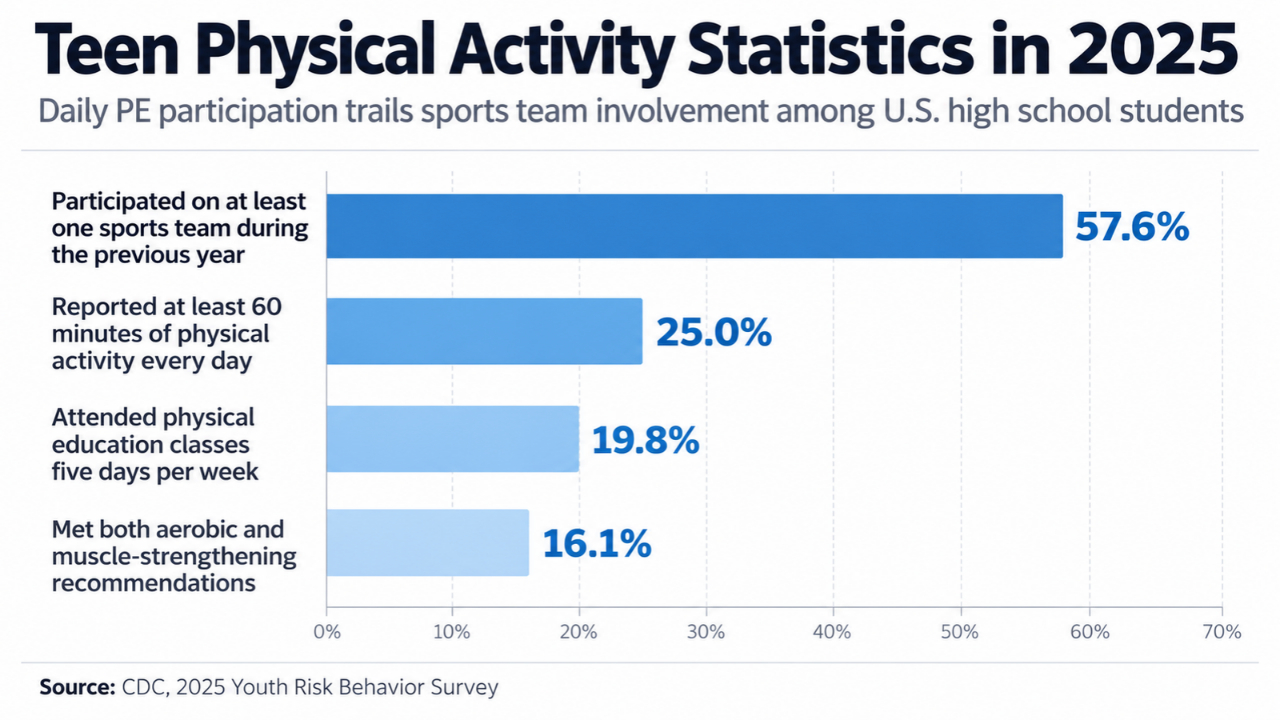
The PE figure bothers me most. Daily PE participation declined significantly between 2023 and 2025, while sports-team participation increased. Those measures cover different periods, but the contrast is worth examining.
As I discussed in my earlier analysis of declining teen physical activity, several major activity indicators have deteriorated over the past decade.
Yet the latest findings suggest that organized sports and everyday school-based activity aren’t necessarily moving in the same direction.
Teenagers haven’t collectively abandoned exercise. Millions remain interested in sports and physical challenges. The problem is that regular activity isn’t reaching enough students.
And while these CDC figures cover high school students rather than every school-aged child, they raise an uncomfortable question: Why are we adding another fitness assessment when daily PE participation is moving backward?
Schools Have Changed Since 2012
It would be a mistake to treat the Presidential Fitness Test’s return as though schools had been waiting unchanged for its comeback. Consider how teenagers spend their free time.
In 2012, Pew Research Center found that 23% of teenagers ages 12 to 17 owned smartphones. By 2024, 95% of teenagers ages 13 to 17 reported having access to one at home.
Those figures measure slightly different things, but the transformation in teenagers’ digital environment is unmistakable.
Schools are also navigating the lasting effects of pandemic-era disruptions, competing academic demands, and a greater awareness of students’ differing physical and emotional needs.
None of this means smartphones automatically cause inactivity or that today’s children are less motivated than previous generations.
I dislike those explanations because they shift responsibility almost entirely onto young people.
A child who cannot afford organized sports, has limited transportation, or lacks safe recreational space faces obstacles that a fitness award cannot address.
And students with disabilities or chronic health conditions need assessments and activities appropriate to their abilities, not a system that mistakes a particular physical limitation for unwillingness to exercise.
A standardized score can be useful. Treating it as a complete description of a child’s fitness or effort is bad measurement.
Fitness Testing Should Be Part of Teaching, Not the Main Event
View this post on Instagram
In exercise science, we distinguish between assessing performance and creating the adaptations that improve it.
That distinction should guide how schools use the returning test.
I would rather see a student improve their mile time substantially over a semester than watch an already athletic student collect another certificate without learning anything new.
Both achievements have value, but one tells us much more about what the school’s instruction accomplished.
Students should have opportunities to practice the assessed movements beforehand. Their results should remain private, and teachers should help them understand what the measurements mean.
Scores should never become a public ranking of children who differ in maturity, training history, health, and access to exercise.
Most importantly, fitness assessments should be connected to actual opportunities for improvement.
A CDC survey found that nearly 40 million American adults cannot swim, a reminder that physical education should also teach essential water-safety skills.
The CDC recommends comprehensive school activity programs combining PE with recess, classroom activity, extracurricular opportunities, and family engagement.
That’s a more useful approach than treating one testing day as the centerpiece of school fitness.
There’s also evidence that teenagers respond when opportunities become more accessible.
This summer, teenagers recorded 19.4 million free workouts through Planet Fitness’s High School Summer Pass program.
A commercial gym promotion isn’t a substitute for public school PE. But that level of participation challenges the idea that young people simply don’t want to exercise.
The $10 Million Challenge Raises Another Question
On October 1, HHS announced the Presidential Fitness School Innovation Challenge, offering $10 million in prizes and equipment support.
$10 MILLION to GET KIDS ACTIVE!
HHS’s Presidential Fitness School Innovation Challenge will reward schools and youth organizations that bring fitness, healthy competition, and lifelong healthy habits to the next generation.
Learn more by visiting https://t.co/4Oq7JdaGqq. https://t.co/r3a9WREkEO
— HHS (@HHSGov) October 5, 2026
The competition includes $7 million for innovative implementation projects and $3 million in equipment vouchers and recognition awards.
That’s an encouraging investment, particularly for organizations that can turn testing into sustained activity programs.
But prize competitions aren’t the same thing as reliable funding for PE teachers, facilities, and regular instruction.
I want to know whether the schools best positioned to win these awards are also the schools that already have the staff and resources to implement strong fitness programs.
If that’s what happens, the initiative could end up rewarding existing advantages.
I would also like to see schools judged on something beyond test participation and high scores: how much additional activity they provide, how many previously inactive students they reach, and whether those opportunities continue after the competition ends.
Those measures would tell us whether the initiative is changing children’s routines rather than merely documenting their performance.
The Real Test Is What Happens After Test Day
@cbsmornings The Presidential Fitness Test is returning to some U.S. schools this year. It comes as the CDC says only about 1-in-6 students get the recommended amount of physical and muscle-strengthening activity. Dr. Amanda Kravitz, a pediatrician at Weill Cornell Medicine, shares about encouraging children to get more physically active and explains why she believes the test is a starting point in that goal. #fitness #exercise #health #backtoschool ♬ original sound – CBS Mornings
I don’t think the Presidential Fitness Test should have remained permanently retired simply because some students had unpleasant experiences with it.
Well-designed assessments can teach children about endurance, strength, goal-setting, and improvement.
And some students will understandably take enormous pride in earning a Presidential Fitness Award.
But nostalgia should have no role in determining whether an education policy works.
The schools receiving this test in 2026 face different challenges from those that used it before 2012. The CDC’s latest findings make clear that everyday physical activity remains far too uncommon, even while participation in organized sports has improved.
My hope is that the renewed national attention produces more opportunities to move, not simply more numbers to record.
If a school administers the test in October and offers little meaningful physical activity for the rest of the year, I would call that a failure regardless of how many certificates it distributes.
The Presidential Fitness Test’s success shouldn’t be measured by how many children pass it. It should be measured by how many children become more active because it returned.